c.curionodeThe Fields Archive

1974 · Number theory

Finding order by averaging errors

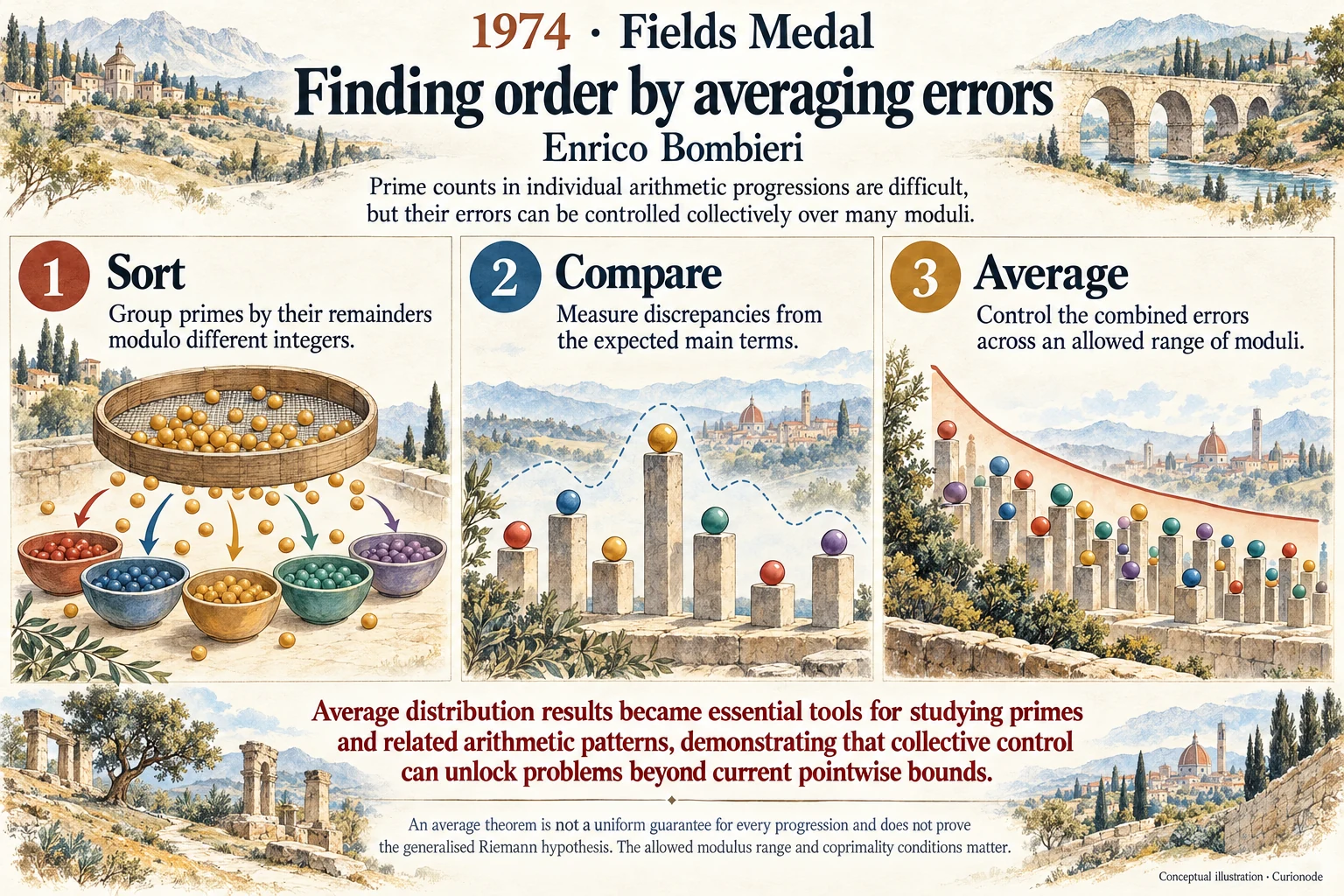
Prime counts in individual arithmetic progressions are difficult, but their errors can be controlled collectively over many moduli.

1974Fields Medal
Finding order by averaging errors: Prime counts in individual arithmetic progressions are difficult, but their errors can be controlled collectively over many moduli.
Original AI-generated infographic by Curionode. Read the text version below for the full explanation.
Read the poster text
  1. Sort

    Group primes by their remainders modulo different integers.

  2. Compare

    Measure discrepancies from the expected main terms.

  3. Average

    Control the combined errors across an allowed range of moduli.

Average distribution results became essential tools for studying primes and related arithmetic patterns, demonstrating that collective control can unlock problems beyond current pointwise bounds.


An average theorem is not a uniform guarantee for every progression and does not prove the generalised Riemann hypothesis. The allowed modulus range and coprimality conditions matter.

01 · The idea

In everyday language

Look for primes among numbers with one fixed remainder modulo q. For a remainder coprime to q, a natural main term predicts how primes should be distributed. The error is difficult to control uniformly for every modulus. The Bombieri–Vinogradov theorem, proved independently by Bombieri and Vinogradov, gives strong bounds after averaging over a substantial range of moduli. Large-sieve estimates are central to this approach. Averaging does not make each error disappear; it limits how large the collection of discrepancies can be and supplies a powerful substitute for some unavailable individual estimates.

Why it matters

Average distribution results became essential tools for studying primes and related arithmetic patterns, demonstrating that collective control can unlock problems beyond current pointwise bounds.

02 · The people

Who brought the idea to life?

Illustrated portrait of Enrico Bombieri

Enrico Bombieri

Enrico Bombieri was born in Milan in 1940. His research ranges from prime numbers and Diophantine approximation to complex analysis and minimal surfaces. The 1974 Fields Medal recognised this exceptional breadth. His institutional career moved from the University of Pisa to the Scuola Normale Superiore in 1974, and both are recorded here rather than substituting his later Princeton appointment. In number theory his large-sieve methods and work on primes in arithmetic progressions showed the strength of averaging: a collection of difficult errors can sometimes be controlled more sharply together than separately.

Read the biography ↗

03 · Read further

From the original sources

Original explanations based on the official award record. The subject label is an editorial navigation aid.

  1. Official IMU citation: Enrico Bombieri ↗www.mathunion.org
  2. Heidelberg Laureate Forum: Enrico Bombieri ↗www.heidelberg-laureate-forum.org
  3. Institute for Advanced Study: Bombieri appointment chronology ↗www.ias.edu