c.curionodeThe Fields Archive

1978 · Algebra & representation

Giving algebra a higher-dimensional memory

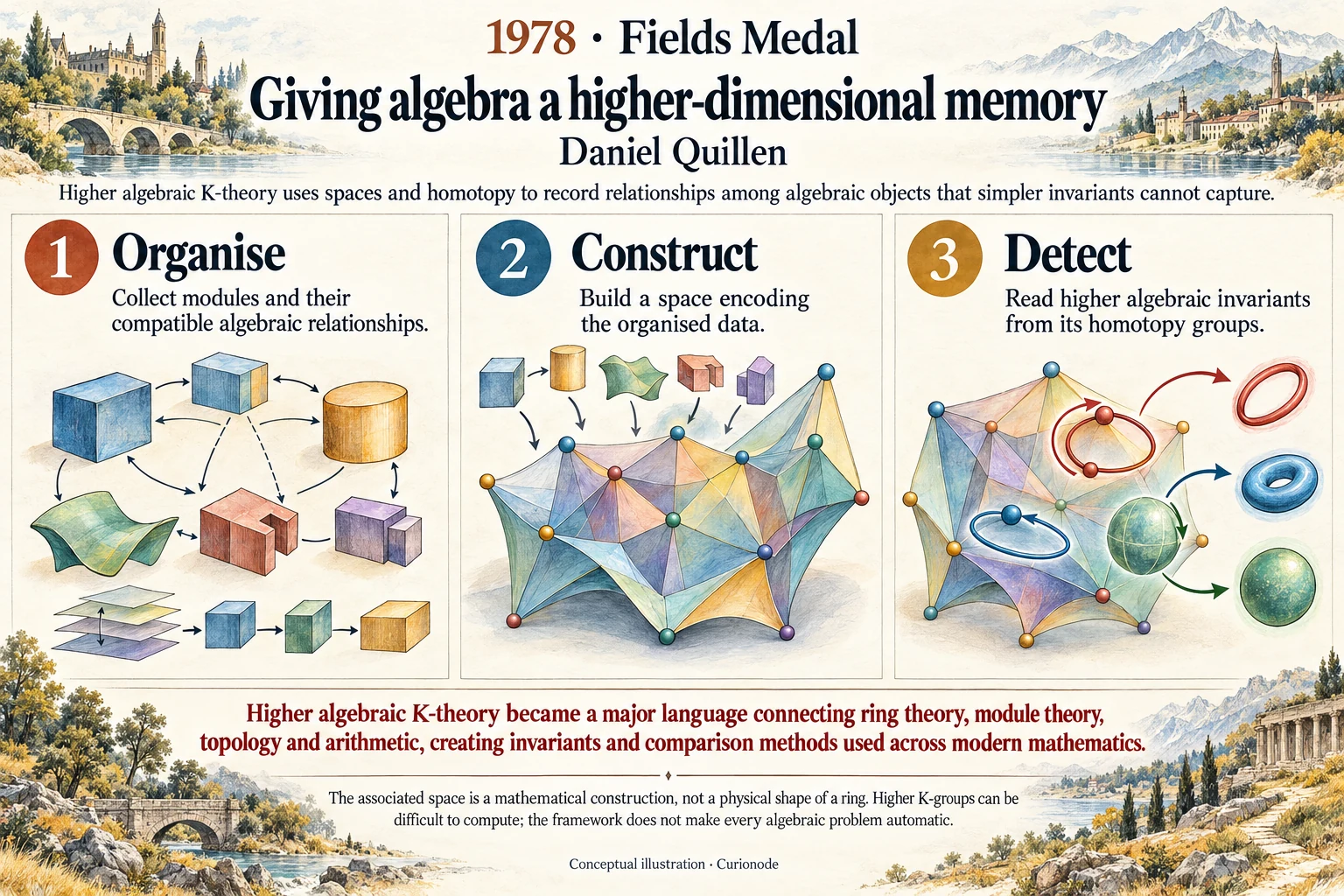
Higher algebraic K-theory uses spaces and homotopy to record relationships among algebraic objects that simpler invariants cannot capture.

1978Fields Medal
Giving algebra a higher-dimensional memory: Higher algebraic K-theory uses spaces and homotopy to record relationships among algebraic objects that simpler invariants cannot capture.
Original AI-generated infographic by Curionode. Read the text version below for the full explanation.
Read the poster text
  1. Organise

    Collect modules and their compatible algebraic relationships.

  2. Construct

    Build a space encoding the organised data.

  3. Detect

    Read higher algebraic invariants from its homotopy groups.

Higher algebraic K-theory became a major language connecting ring theory, module theory, topology and arithmetic, creating invariants and comparison methods used across modern mathematics.

The associated space is a mathematical construction, not a physical shape of a ring. Higher K-groups can be difficult to compute; the framework does not make every algebraic problem automatic.

01 · The idea

In everyday language

A ring has modules, and modules have maps, decompositions and exact sequences. Low-dimensional invariants can summarise some of this structure, but they miss higher relationships. Quillen constructed spaces from organised algebraic data and defined higher K-groups through their homotopy groups. His different constructions connected with one another, giving the theory consistency and powerful computational tools. The shift is conceptual: rather than merely count algebraic objects, preserve how they relate and how those relations themselves fit together. Topology then becomes a means of detecting deeper algebraic information.

Why it matters

Higher algebraic K-theory became a major language connecting ring theory, module theory, topology and arithmetic, creating invariants and comparison methods used across modern mathematics.

02 · The people

Who brought the idea to life?

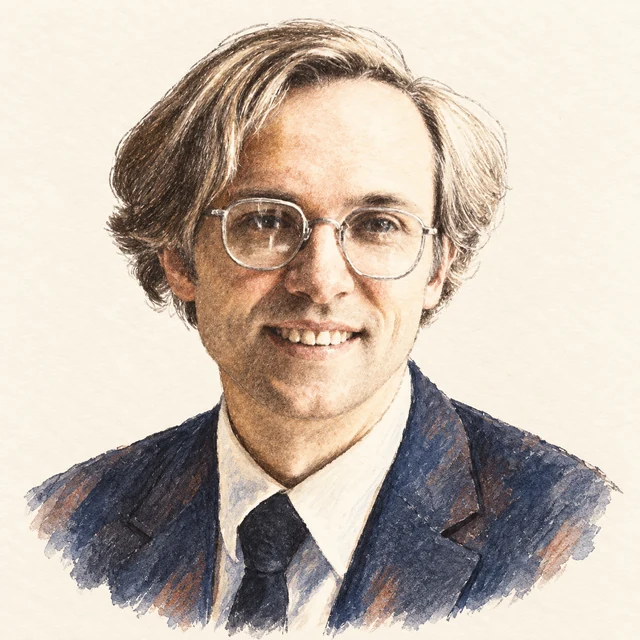
Illustrated portrait of Daniel Quillen

Daniel Quillen

Daniel Quillen was born in Orange, New Jersey, in 1940. He received the 1978 Fields Medal while at MIT for the creation of higher algebraic K-theory and related foundational advances. His work brought methods from homotopy theory into algebra, attaching geometric structures and higher invariants to rings and modules. Instead of treating algebraic objects only through equations and presentations, he organised their relationships into spaces whose topology could be studied. His constructions supplied a coherent theory where earlier definitions had offered only fragments, opening new questions throughout algebra and arithmetic.

Read the biography ↗

03 · Read further

From the original sources

Original explanations based on the official award record. The subject label is an editorial navigation aid.

  1. Official IMU citation: Daniel Quillen ↗www.mathunion.org
  2. Heidelberg Laureate Forum: Daniel Quillen ↗www.heidelberg-laureate-forum.org
  3. MIT: memorial account of Daniel Quillen and higher K-theory ↗math.mit.edu