c.curionodeThe Fields Archive

1986 · Geometry & topology

Classify four-dimensional spaces by topological data

New disk techniques make four-dimensional topology accessible where ordinary surgery methods fail.

1986Fields Medal
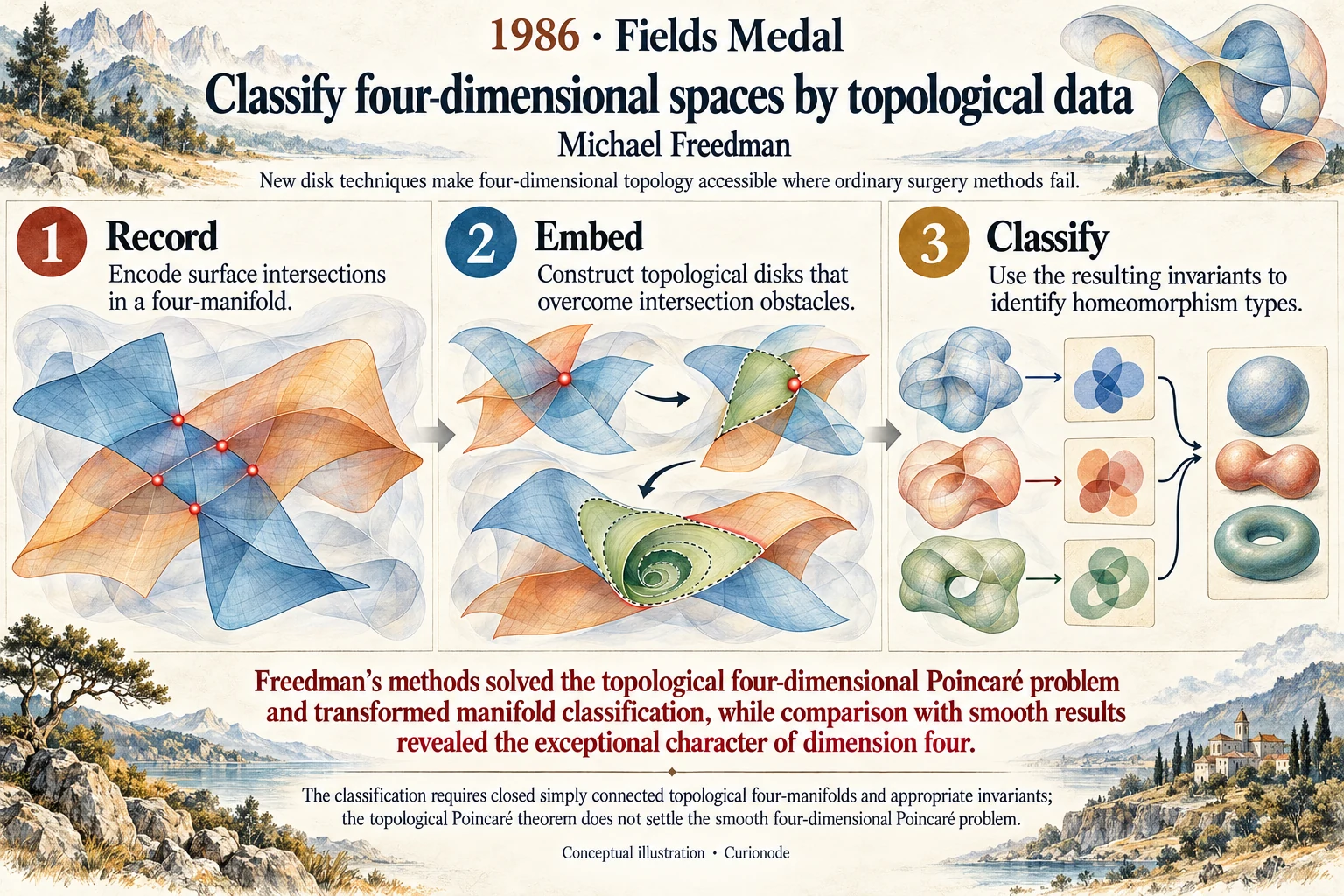
Classify four-dimensional spaces by topological data: New disk techniques make four-dimensional topology accessible where ordinary surgery methods fail.
Original AI-generated infographic by Curionode. Read the text version below for the full explanation.
Read the poster text
  1. Record

    Encode surface intersections in a four-manifold.

  2. Embed

    Construct topological disks that overcome intersection obstacles.

  3. Classify

    Use the resulting invariants to identify homeomorphism types.

Freedman’s methods solved the topological four-dimensional Poincaré problem and transformed manifold classification, while comparison with smooth results revealed the exceptional character of dimension four.


The classification requires closed simply connected topological four-manifolds and appropriate invariants; the topological Poincaré theorem does not settle the smooth four-dimensional Poincaré problem.

01 · The idea

In everyday language

To simplify a manifold, topologists often use disks to remove intersections between surfaces. In dimension four this is delicate because two-dimensional surfaces meet in isolated points, and attempts to remove intersections can create new ones. Freedman developed methods that control infinite constructions and produce the topological disks needed for the argument. For closed simply connected four-manifolds, intersection forms, together with a further invariant, then organise the homeomorphism classification. One consequence identifies a homotopy four-sphere with the usual sphere topologically. The classification concerns continuous topology: its coordinate changes need not be differentiable, and it leaves separate smooth questions untouched.

Why it matters

Freedman’s methods solved the topological four-dimensional Poincaré problem and transformed manifold classification, while comparison with smooth results revealed the exceptional character of dimension four.

02 · The people

Who brought the idea to life?

Illustrated portrait of Michael Freedman

Michael Freedman

Michael Freedman was born in Los Angeles and was a professor at the University of California, San Diego, when he received the 1986 Fields Medal. He developed new methods for topological four-manifolds, where familiar higher-dimensional surgery arguments encounter special difficulties. His disk-embedding techniques led to a classification of closed simply connected topological four-manifolds using intersection forms together with an additional topological invariant. A major consequence was the topological four-dimensional Poincaré theorem: a homotopy four-sphere is homeomorphic to the standard sphere. His results allow continuous coordinate changes and should be distinguished from smooth classification, where Donaldson’s work revealed much stronger restrictions.

Read the biography ↗

03 · Read further

From the original sources

Original explanations based on the official award record. The subject label is an editorial navigation aid.

  1. Official IMU citation: Michael Freedman ↗www.mathunion.org
  2. Heidelberg Laureate Forum: Michael Freedman ↗www.heidelberg-laureate-forum.org
  3. UC San Diego Mathematics: Department history ↗www.math.ucsd.edu