c.curionodeThe Fields Archive

1986 · Geometry & topology

Smoothness changes what four-dimensional space permits

Gauge equations detect restrictions that continuous topology alone cannot see.

1986Fields Medal
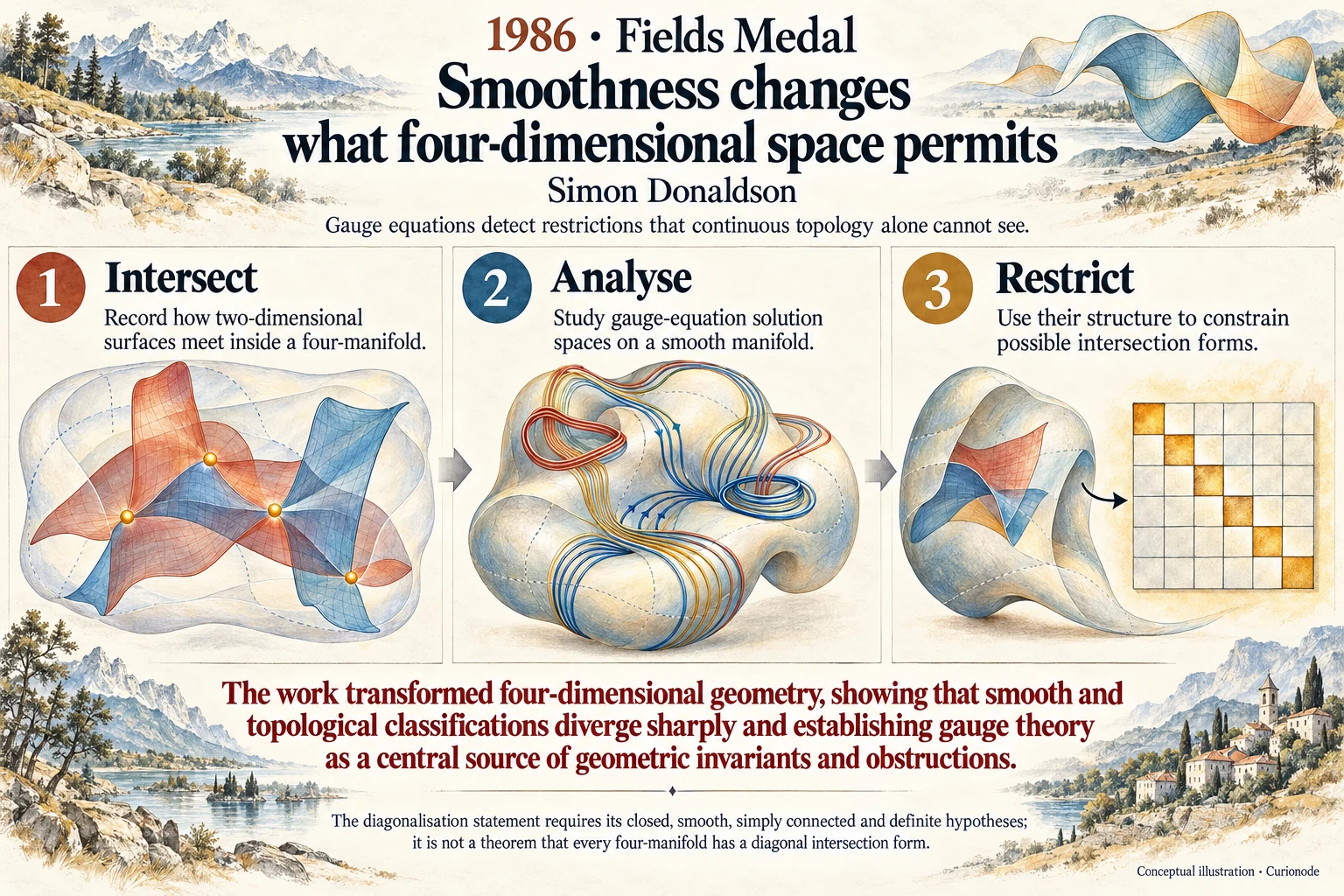
Smoothness changes what four-dimensional space permits: Gauge equations detect restrictions that continuous topology alone cannot see.
Original AI-generated infographic by Curionode. Read the text version below for the full explanation.
Read the poster text
  1. Intersect

    Record how two-dimensional surfaces meet inside a four-manifold.

  2. Analyse

    Study gauge-equation solution spaces on a smooth manifold.

  3. Restrict

    Use their structure to constrain possible intersection forms.

The work transformed four-dimensional geometry, showing that smooth and topological classifications diverge sharply and establishing gauge theory as a central source of geometric invariants and obstructions.


The diagonalisation statement requires its closed, smooth, simply connected and definite hypotheses; it is not a theorem that every four-manifold has a diagonal intersection form.

01 · The idea

In everyday language

Surfaces inside an oriented four-manifold intersect in isolated points, and their signed intersections form an algebraic object called the intersection form. Topological four-manifolds can realise forms that smooth ones cannot. Donaldson studied spaces of solutions to the anti-self-dual Yang–Mills equations and extracted consequences for smooth manifolds. His diagonalisation theorem says that a definite intersection form of a closed smooth simply connected four-manifold is diagonal over the integers. Comparing this with topological existence theorems shows that some spaces cannot carry any smooth structure. The striking conclusion is that asking for well-defined calculus changes the possibilities for a space.

Why it matters

The work transformed four-dimensional geometry, showing that smooth and topological classifications diverge sharply and establishing gauge theory as a central source of geometric invariants and obstructions.

02 · The people

Who brought the idea to life?

Illustrated portrait of Simon Donaldson

Simon Donaldson

Simon Donaldson was born in Cambridge, England, and worked at Oxford when he received the 1986 Fields Medal. He brought gauge theory, originally developed in physics, into the study of smooth four-dimensional manifolds. His analysis of solutions to the anti-self-dual Yang–Mills equations imposed unexpected restrictions on their topology. In particular, his diagonalisation theorem sharply constrained definite intersection forms of smooth closed simply connected four-manifolds. Compared with Freedman’s topological classification, these restrictions exposed a dramatic gap between continuous and smooth geometry. Their interaction also revealed exotic smooth structures on four-dimensional Euclidean space. Donaldson’s work concerns smooth structure, not a classification that ignores differentiability.

Read the biography ↗

03 · Read further

From the original sources

Original explanations based on the official award record. The subject label is an editorial navigation aid.

  1. Official IMU citation: Simon Donaldson ↗www.mathunion.org
  2. Heidelberg Laureate Forum: Simon Donaldson ↗www.heidelberg-laureate-forum.org
  3. Imperial College London: Simon Donaldson historical profile ↗www.imperial.ac.uk