c.curionodeThe Fields Archive

1990 · Algebraic geometry

Simplify an algebraic shape without losing its core

Contractions and flips reorganise three-dimensional varieties into models suited to classification.

1990Fields Medal
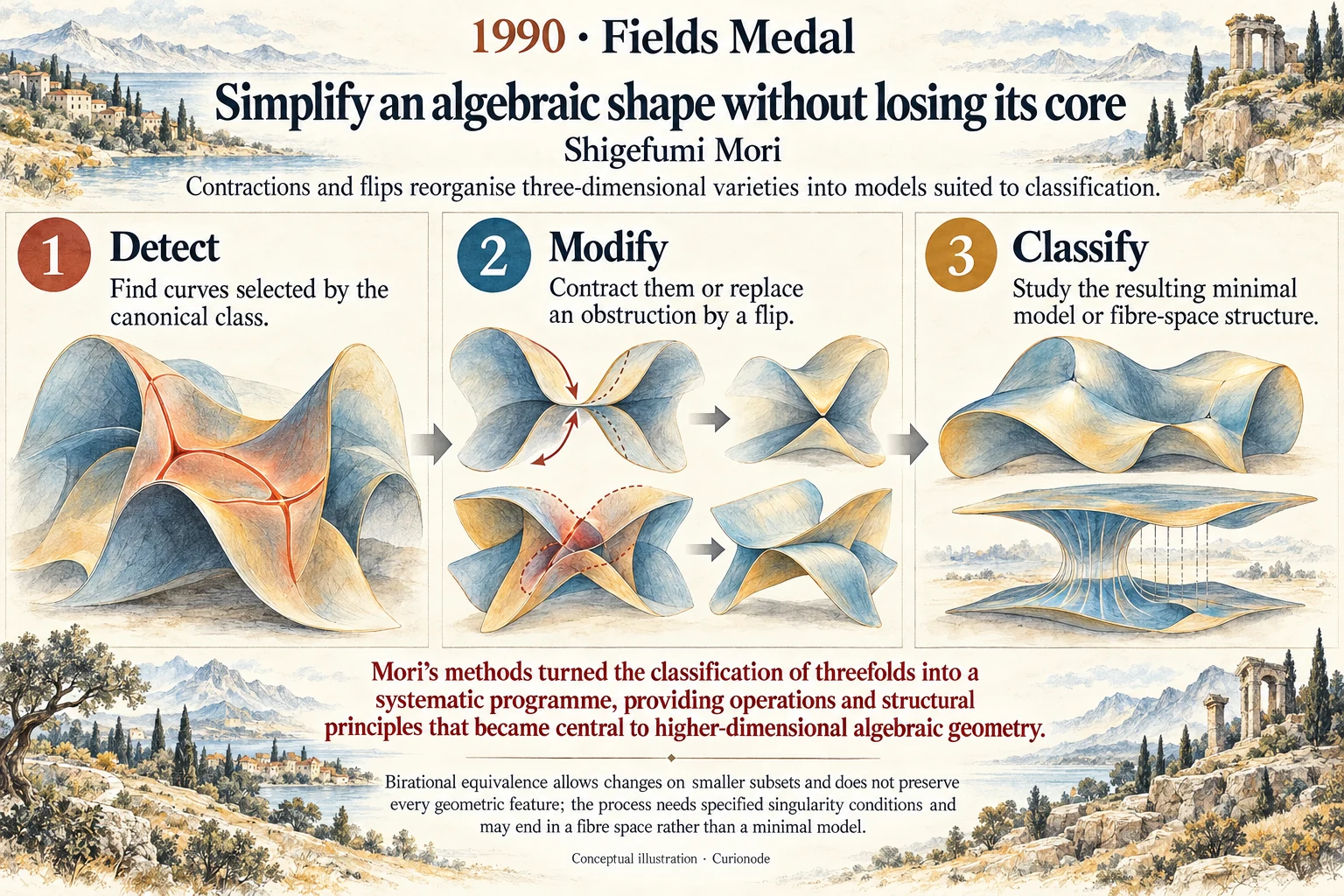
Simplify an algebraic shape without losing its core: Contractions and flips reorganise three-dimensional varieties into models suited to classification.
Original AI-generated infographic by Curionode. Read the text version below for the full explanation.
Read the poster text
  1. Detect

    Find curves selected by the canonical class.

  2. Modify

    Contract them or replace an obstruction by a flip.

  3. Classify

    Study the resulting minimal model or fibre-space structure.

Mori’s methods turned the classification of threefolds into a systematic programme, providing operations and structural principles that became central to higher-dimensional algebraic geometry.

Birational equivalence allows changes on smaller subsets and does not preserve every geometric feature; the process needs specified singularity conditions and may end in a fibre space rather than a minimal model.

01 · The idea

In everyday language

Different polynomial equations can describe varieties that agree away from lower-dimensional subsets. Birational geometry studies this shared structure instead of insisting that every point remain unchanged. The minimal model programme uses the canonical class to detect curves whose contraction can simplify a variety. Sometimes a direct contraction creates an obstruction; a flip replaces the local configuration with another birational model that lets the process continue. Mori’s existence theorem for three-dimensional flips made a crucial operation available. The outcome can be a minimal model or a Mori fibre space. Controlled singularities are part of the method, not an accidental failure of smoothness.

Why it matters

Mori’s methods turned the classification of threefolds into a systematic programme, providing operations and structural principles that became central to higher-dimensional algebraic geometry.

02 · The people

Who brought the idea to life?

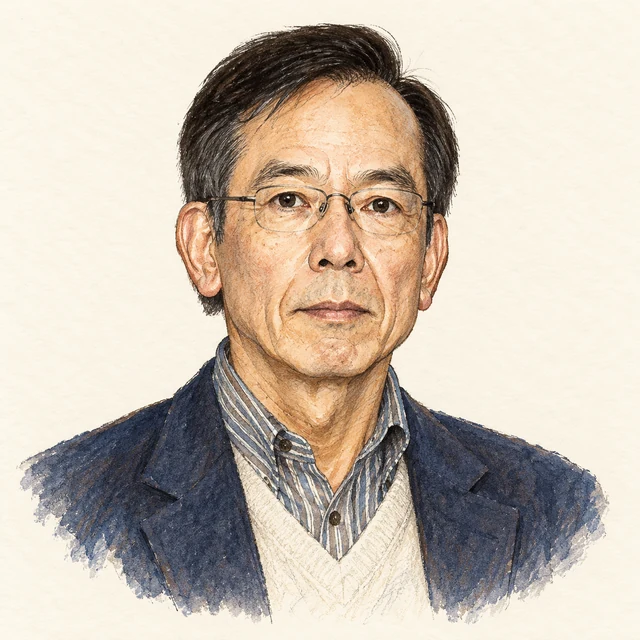
Illustrated portrait of Shigefumi Mori

Shigefumi Mori

Shigefumi Mori was born in Nagoya, Japan, and moved to Kyoto University’s Research Institute for Mathematical Sciences in 1990, the year of his Fields Medal. His work reshaped the classification of algebraic varieties, especially three-dimensional ones. Extremal rays identify directions along which certain curves can be contracted, while flips replace problematic contractions by better-behaved birational models. Mori proved the existence of three-dimensional flips, a decisive step in the minimal model programme. Rather than classify every equation separately, the programme seeks simpler representatives related by rational transformations. Its success requires controlled singularities and can lead to a Mori fibre space as well as a minimal model.

Read the biography ↗

03 · Read further

From the original sources

Original explanations based on the official award record. The subject label is an editorial navigation aid.

  1. Official IMU citation: Shigefumi Mori ↗www.mathunion.org
  2. Heidelberg Laureate Forum: Shigefumi Mori ↗www.heidelberg-laureate-forum.org
  3. Kyoto University: Shigefumi Mori profile ↗kuias.kyoto-u.ac.jp