c.curionodeThe Fields Archive

2002 · Algebraic geometry

Topology enters algebraic geometry

A new cohomology language exposes arithmetic information hidden inside algebraic varieties.

2002Fields Medal
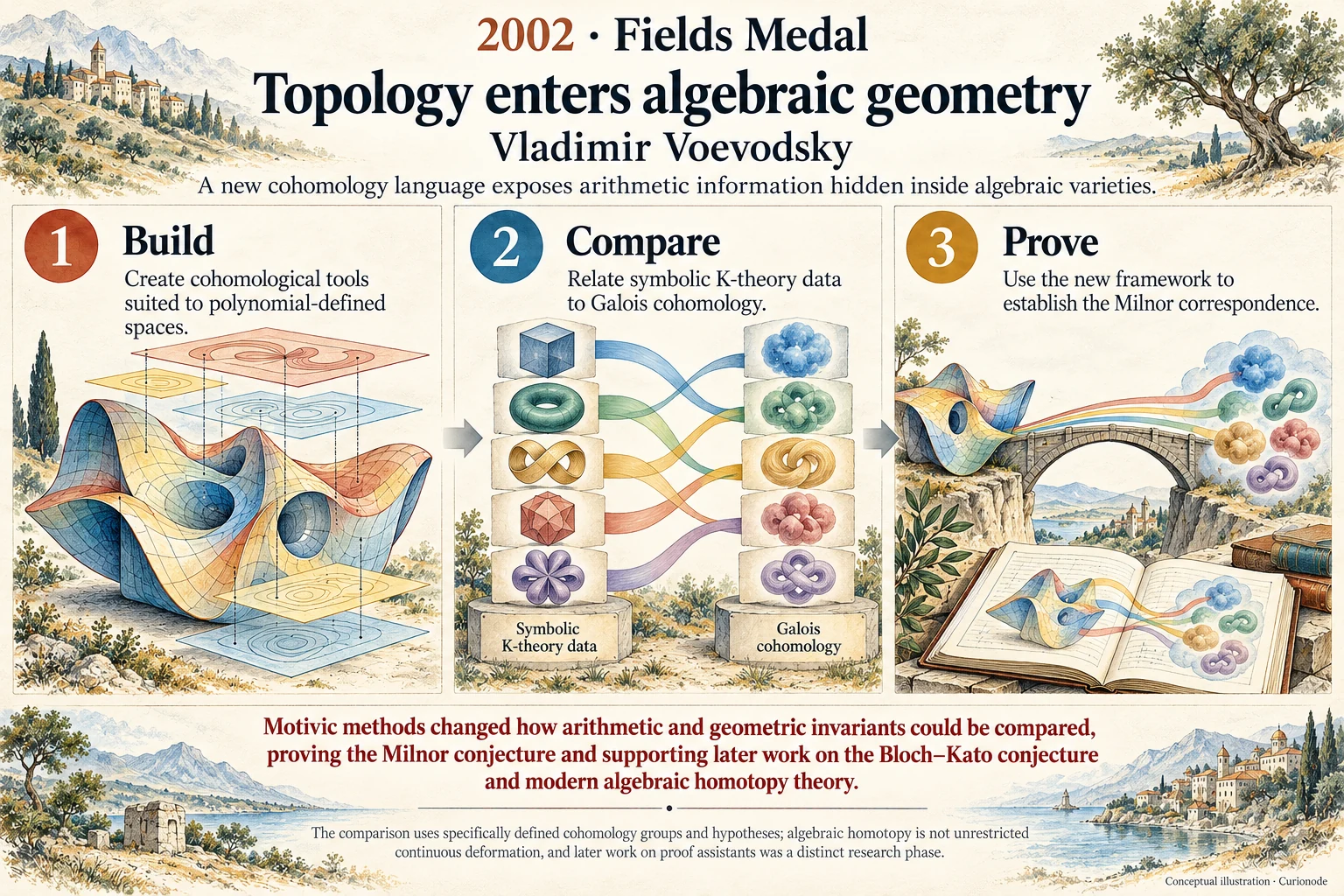
Topology enters algebraic geometry: A new cohomology language exposes arithmetic information hidden inside algebraic varieties.
Original AI-generated infographic by Curionode. Read the text version below for the full explanation.
Read the poster text
  1. Build

    Create cohomological tools suited to polynomial-defined spaces.

  2. Compare

    Relate symbolic K-theory data to Galois cohomology.

  3. Prove

    Use the new framework to establish the Milnor correspondence.

Motivic methods changed how arithmetic and geometric invariants could be compared, proving the Milnor conjecture and supporting later work on the Bloch–Kato conjecture and modern algebraic homotopy theory.


The comparison uses specifically defined cohomology groups and hypotheses; algebraic homotopy is not unrestricted continuous deformation, and later work on proof assistants was a distinct research phase.

01 · The idea

In everyday language

Topology studies features that survive continuous deformation. Algebraic geometry studies spaces constrained by polynomial equations, where ordinary deformation methods do not transfer directly. Voevodsky developed a framework that gives these rigid spaces analogues of topological tools. Motivic cohomology organises algebraic cycles into groups and connects them with other invariants. In the Milnor conjecture, symbols built from nonzero field elements, taken modulo two, match appropriate Galois cohomology classes. Proving this required a new conceptual setting in which relations invisible in a single calculation could become structural facts. The machinery reaches far beyond this one conjecture.

Why it matters

Motivic methods changed how arithmetic and geometric invariants could be compared, proving the Milnor conjecture and supporting later work on the Bloch–Kato conjecture and modern algebraic homotopy theory.

02 · The people

Who brought the idea to life?

Illustrated portrait of Vladimir Voevodsky

Vladimir Voevodsky

Vladimir Voevodsky was born in Moscow in the Soviet Union and received the 2002 Fields Medal shortly after becoming a professor at the Institute for Advanced Study. He brought methods inspired by topology into algebraic geometry, helping create motivic cohomology and an algebraic version of homotopy theory. These tools yielded his proof of the Milnor conjecture, relating algebraic K-theory and Galois cohomology. His later research turned toward foundations and computer-checked proofs, including univalent foundations. That later programme grew from his concern for reliable mathematical reasoning, but the Fields Medal primarily recognised his earlier transformation of algebraic geometry and its arithmetic connections.

Read the biography ↗

03 · Read further

From the original sources

Original explanations based on the official award record. The subject label is an editorial navigation aid.

  1. Official IMU citation: Vladimir Voevodsky ↗www.mathunion.org
  2. Heidelberg Laureate Forum: Vladimir Voevodsky ↗www.heidelberg-laureate-forum.org
  3. IAS: Vladimir Voevodsky 1966–2017 ↗www.ias.edu