01 · A life in mathematics
The person behind the work
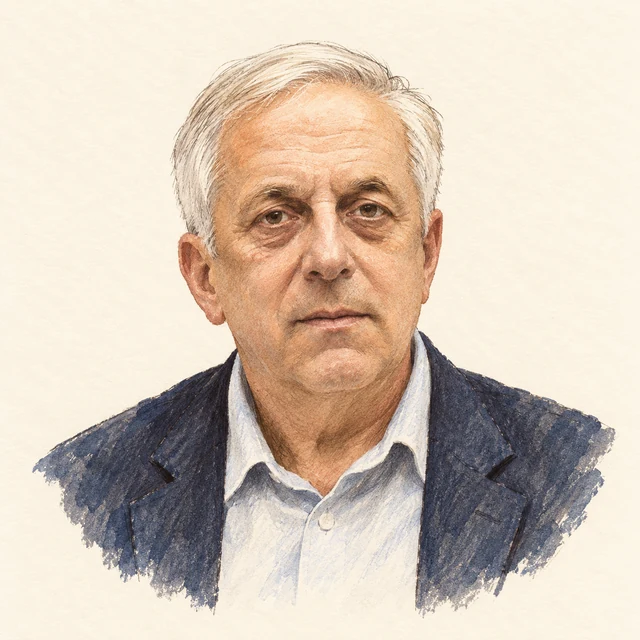
Gregory Margulis was born in Moscow in 1946. His research connected Lie groups, ergodic theory, geometry and arithmetic through powerful rigidity theorems. He received the 1978 Fields Medal while working at Moscow’s Institute for Problems of Information Transmission; the Abel Prize biography documents this appointment and the discrimination that prevented a university position. Soviet authorities did not permit him to attend the medal ceremony in Helsinki. His arithmeticity and superrigidity methods revealed how strongly a discrete group can be constrained by its continuous surroundings, creating lasting connections among several mathematical disciplines.
The contribution, explained
A lattice is a discrete subgroup of a Lie group with a finite-volume quotient. Such a subgroup may look like a scattered collection inside a continuous space. Margulis showed that suitable irreducible lattices in higher-rank semisimple Lie groups have extraordinary rigidity: their representations are strongly constrained, and they arise from arithmetic constructions. Ergodic methods help turn information about group actions into global algebraic conclusions. The point is not that every grid is inflexible, but that precise hypotheses force a deep connection between discrete symmetry, continuous geometry and number theory.
Why it matters
Arithmeticity and superrigidity transformed the study of lattices and group actions, establishing methods that connect homogeneous dynamics with geometry, representation theory and arithmetic.