c.curionodeThe Fields Archive

1978 · Probability & dynamics

When a lattice is more rigid than it looks

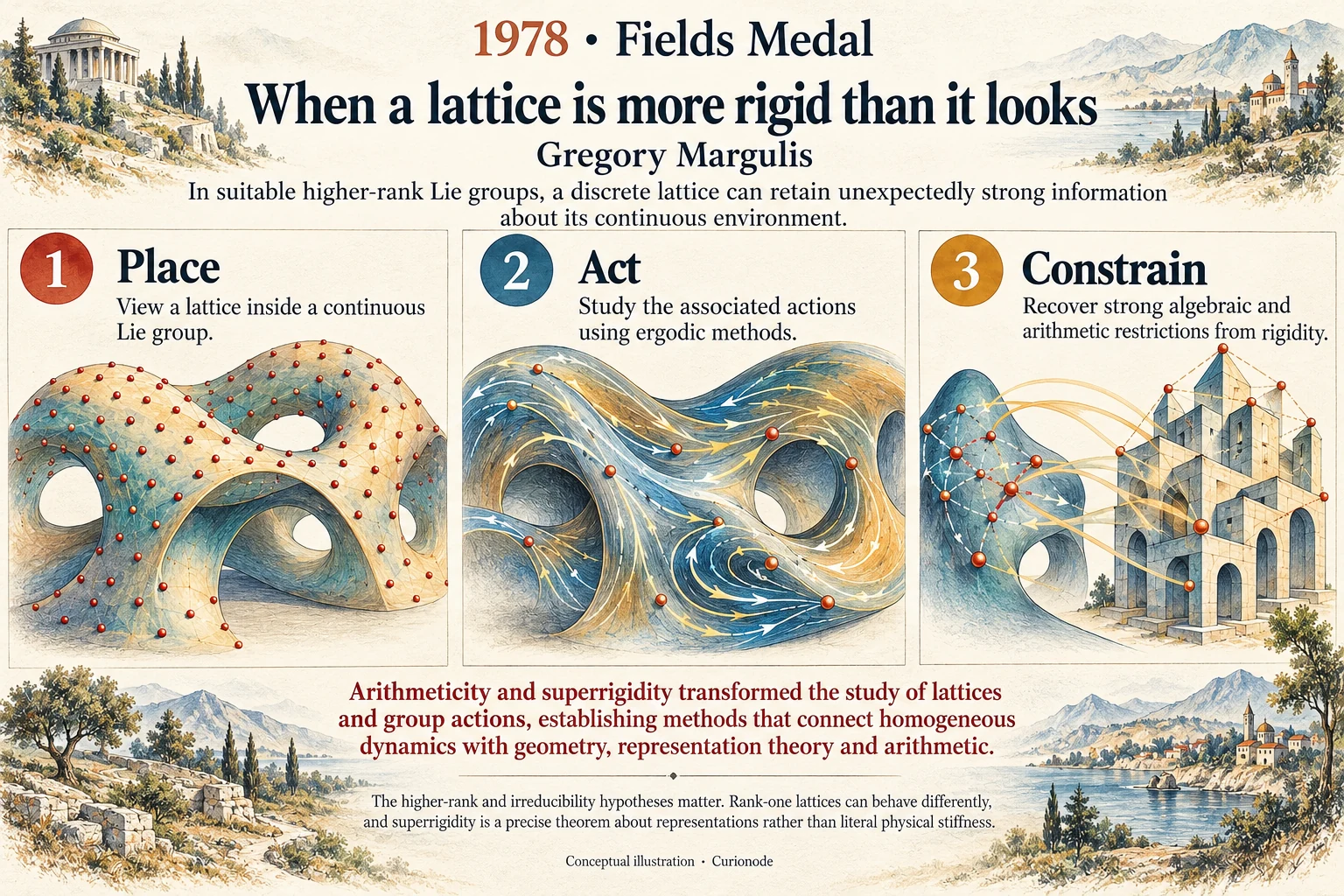
In suitable higher-rank Lie groups, a discrete lattice can retain unexpectedly strong information about its continuous environment.

1978Fields Medal
When a lattice is more rigid than it looks: In suitable higher-rank Lie groups, a discrete lattice can retain unexpectedly strong information about its continuous environment.
Original AI-generated infographic by Curionode. Read the text version below for the full explanation.
Read the poster text
  1. Place

    View a lattice inside a continuous Lie group.

  2. Act

    Study the associated actions using ergodic methods.

  3. Constrain

    Recover strong algebraic and arithmetic restrictions from rigidity.

Arithmeticity and superrigidity transformed the study of lattices and group actions, establishing methods that connect homogeneous dynamics with geometry, representation theory and arithmetic.

The higher-rank and irreducibility hypotheses matter. Rank-one lattices can behave differently, and superrigidity is a precise theorem about representations rather than literal physical stiffness.

01 · The idea

In everyday language

A lattice is a discrete subgroup of a Lie group with a finite-volume quotient. Such a subgroup may look like a scattered collection inside a continuous space. Margulis showed that suitable irreducible lattices in higher-rank semisimple Lie groups have extraordinary rigidity: their representations are strongly constrained, and they arise from arithmetic constructions. Ergodic methods help turn information about group actions into global algebraic conclusions. The point is not that every grid is inflexible, but that precise hypotheses force a deep connection between discrete symmetry, continuous geometry and number theory.

Why it matters

Arithmeticity and superrigidity transformed the study of lattices and group actions, establishing methods that connect homogeneous dynamics with geometry, representation theory and arithmetic.

02 · The people

Who brought the idea to life?

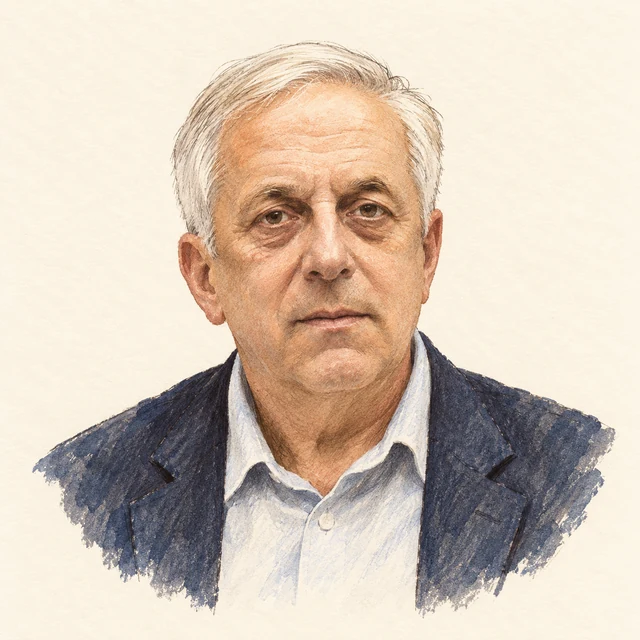
Illustrated portrait of Gregory Margulis

Gregory Margulis

Gregory Margulis was born in Moscow in 1946. His research connected Lie groups, ergodic theory, geometry and arithmetic through powerful rigidity theorems. He received the 1978 Fields Medal while working at Moscow’s Institute for Problems of Information Transmission; the Abel Prize biography documents this appointment and the discrimination that prevented a university position. Soviet authorities did not permit him to attend the medal ceremony in Helsinki. His arithmeticity and superrigidity methods revealed how strongly a discrete group can be constrained by its continuous surroundings, creating lasting connections among several mathematical disciplines.

Read the biography ↗

03 · Read further

From the original sources

Original explanations based on the official award record. The subject label is an editorial navigation aid.

  1. Official IMU citation: Gregory Margulis ↗www.mathunion.org
  2. Heidelberg Laureate Forum: Gregory Margulis ↗www.heidelberg-laureate-forum.org
  3. Abel Prize: biography of Gregory Margulis ↗abelprize.no