01 · A life in mathematics
The person behind the work
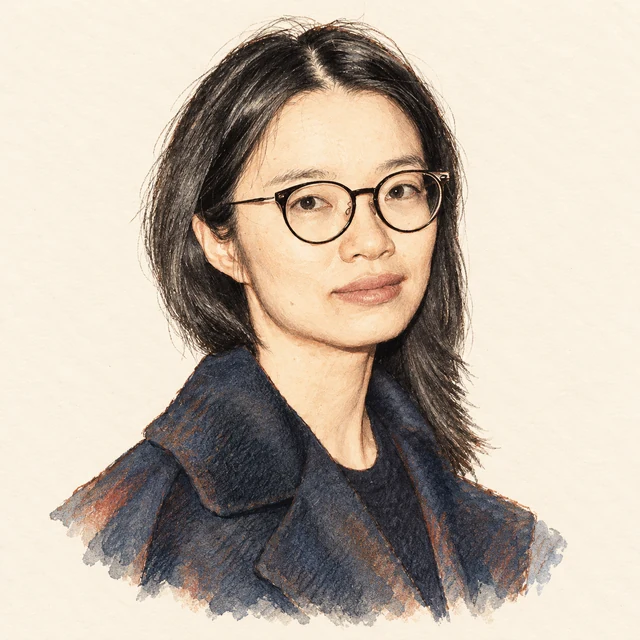
Hong Wang, born in Guangxi, works in harmonic analysis and geometric measure theory. She studied at Peking University and École Polytechnique and received her doctorate from MIT in 2019. At her 2026 Fields Medal she held professorships at IHES in France and New York University. Her collaborations established major results on local smoothing for waves, distance sets, Furstenberg sets and the three-dimensional Kakeya problem. A recurring theme is to analyze many thin tubes or oscillating waves at successive scales, using the geometry of their overlap to control phenomena that no single-scale estimate can adequately describe.
The contribution, explained
Imagine placing a unit line segment in every possible direction in three-dimensional space. How small can the set containing them all be? Ordinary volume is misleading: Kakeya sets can have measure zero. The sharper question asks for their Hausdorff dimension, which detects size through coverings at arbitrarily fine scales. Wang and Joshua Zahl developed a multiscale analysis of thin tubes and their overlap, resolving the three-dimensional Kakeya set conjecture. Their work shows that such a set must nevertheless have full dimension three. This geometric problem is closely connected to controlling oscillatory waves and Fourier transforms in harmonic analysis.
Why it matters
The result settles a central three-dimensional fractal geometry problem and supplies new techniques for arranging and estimating tubes across scales. Wang’s related collaborations also advance wave smoothing, Fourier restriction and distance-set questions.