c.curionodeThe Fields Archive

2026 · Analysis & PDEs

How much space do all directions require?

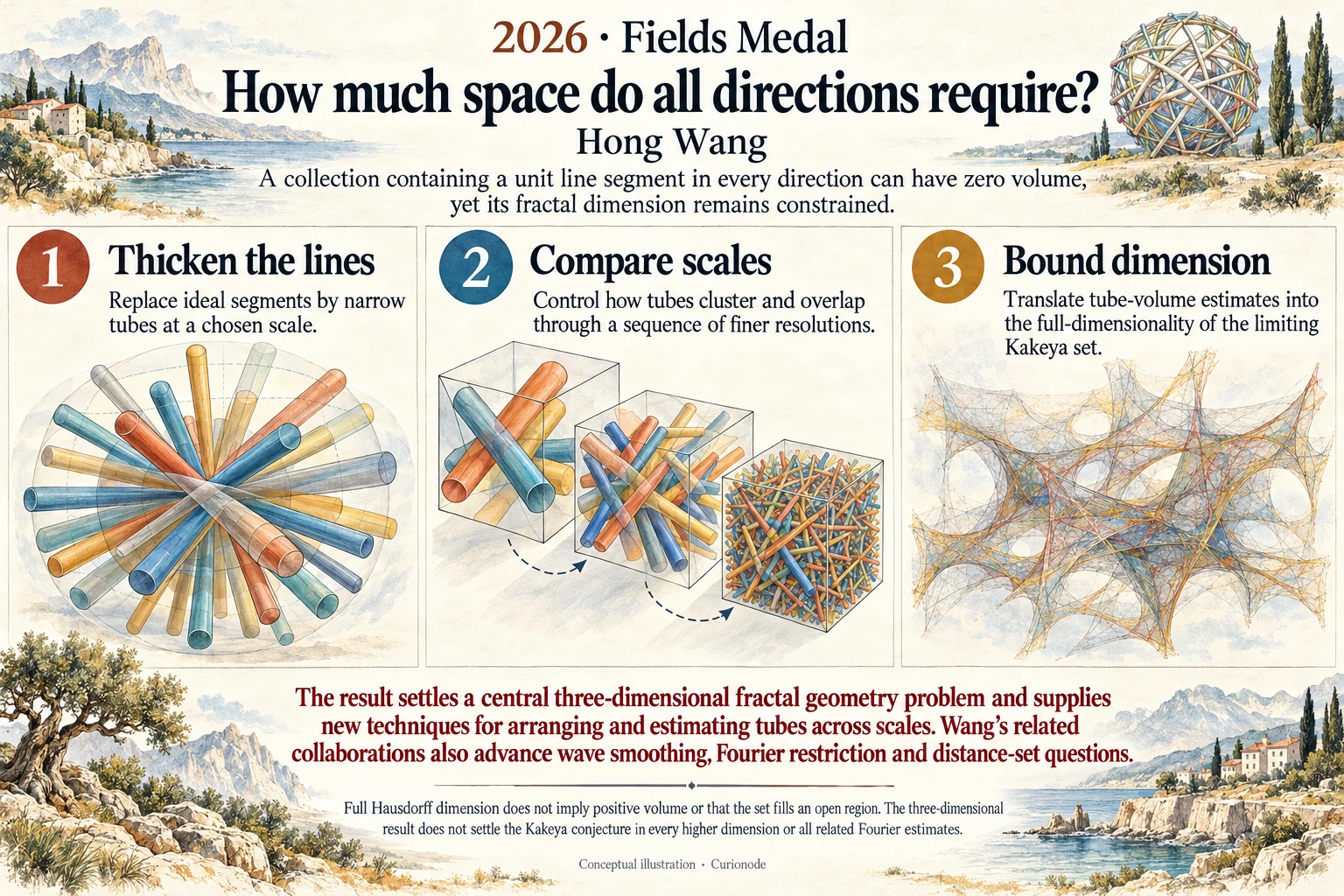
A collection containing a unit line segment in every direction can have zero volume, yet its fractal dimension remains constrained.

2026Fields Medal
How much space do all directions require?: A collection containing a unit line segment in every direction can have zero volume, yet its fractal dimension remains constrained.
Original AI-generated infographic by Curionode. Read the text version below for the full explanation.
Read the poster text
  1. Thicken the lines

    Replace ideal segments by narrow tubes at a chosen scale.

  2. Compare scales

    Control how tubes cluster and overlap through a sequence of finer resolutions.

  3. Bound dimension

    Translate tube-volume estimates into the full-dimensionality of the limiting Kakeya set.

The result settles a central three-dimensional fractal geometry problem and supplies new techniques for arranging and estimating tubes across scales. Wang’s related collaborations also advance wave smoothing, Fourier restriction and distance-set questions.

Full Hausdorff dimension does not imply positive volume or that the set fills an open region. The three-dimensional result does not settle the Kakeya conjecture in every higher dimension or all related Fourier estimates.

01 · The idea

In everyday language

Imagine placing a unit line segment in every possible direction in three-dimensional space. How small can the set containing them all be? Ordinary volume is misleading: Kakeya sets can have measure zero. The sharper question asks for their Hausdorff dimension, which detects size through coverings at arbitrarily fine scales. Wang and Joshua Zahl developed a multiscale analysis of thin tubes and their overlap, resolving the three-dimensional Kakeya set conjecture. Their work shows that such a set must nevertheless have full dimension three. This geometric problem is closely connected to controlling oscillatory waves and Fourier transforms in harmonic analysis.

Why it matters

The result settles a central three-dimensional fractal geometry problem and supplies new techniques for arranging and estimating tubes across scales. Wang’s related collaborations also advance wave smoothing, Fourier restriction and distance-set questions.

02 · The people

Who brought the idea to life?

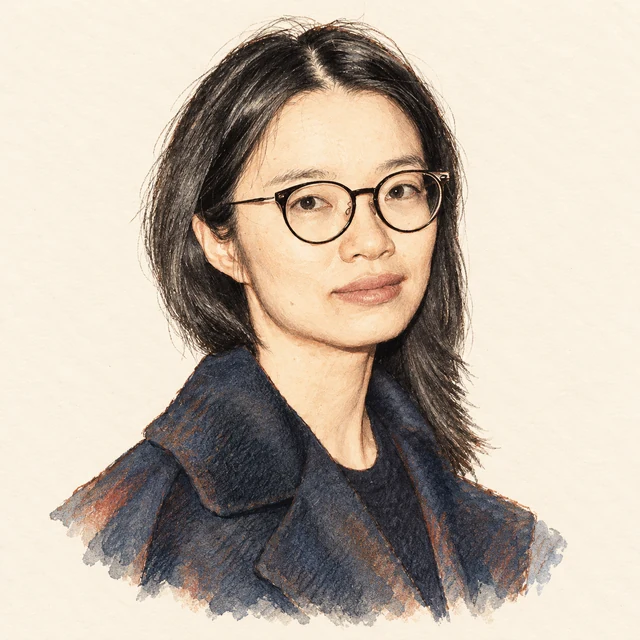
Illustrated portrait of Hong Wang

Hong Wang

Hong Wang, born in Guangxi, works in harmonic analysis and geometric measure theory. She studied at Peking University and École Polytechnique and received her doctorate from MIT in 2019. At her 2026 Fields Medal she held professorships at IHES in France and New York University. Her collaborations established major results on local smoothing for waves, distance sets, Furstenberg sets and the three-dimensional Kakeya problem. A recurring theme is to analyze many thin tubes or oscillating waves at successive scales, using the geometry of their overlap to control phenomena that no single-scale estimate can adequately describe.

Read the biography ↗

03 · Read further

From the original sources

Original explanations based on the official award record. The subject label is an editorial navigation aid.

  1. Official IMU citation: Hong Wang ↗www.mathunion.org
  2. Heidelberg Laureate Forum: Hong Wang ↗www.heidelberg-laureate-forum.org
  3. IHES: Hong Wang awarded the 2026 Fields Medal ↗www.ihes.fr
  4. Peking University: 王虹、邓煜获奖及教育经历 ↗news.pku.edu.cn
  5. IMU: Hong Wang detailed citation ↗www.mathunion.org