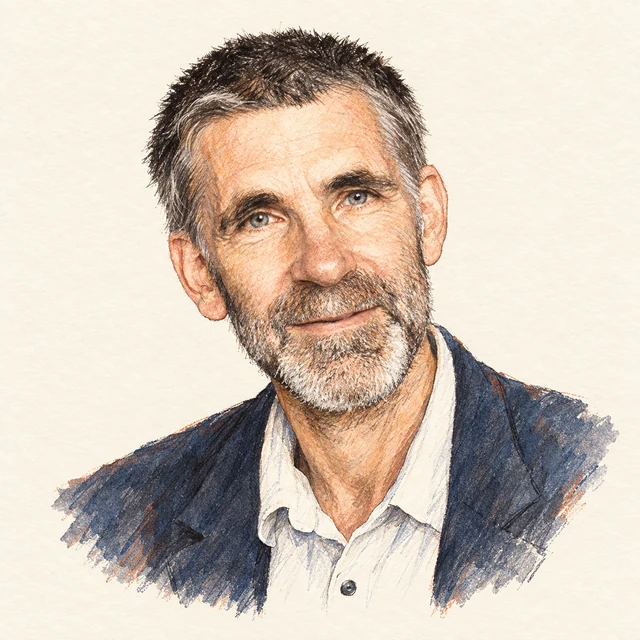
01 · A life in mathematics
The person behind the work
Richard Borcherds was born in Cape Town, South Africa, and trained at Cambridge. At the time of his 1998 Fields Medal he was a Royal Society research professor at Cambridge while on leave from Berkeley, where he had joined the faculty in 1993. His work united vertex algebras, generalised Kac–Moody algebras and automorphic forms. Most famously, he proved monstrous moonshine: a precise relationship between the Monster finite simple group and modular functions. The discovery explained numerical coincidences by constructing a mathematical structure that supported both sides. His medal also recognised new automorphic infinite products, not only the celebrated moonshine theorem.
The contribution, explained
The coefficients of a famous modular function unexpectedly matched dimensions arising from representations of the Monster group. Such a numerical resemblance alone proves nothing: infinitely many coefficients and many symmetry operations must obey exact identities. Borcherds proved that the relationship is structural. Vertex-algebra methods and a generalised Kac–Moody algebra supplied a setting where group representations and modular behaviour could be studied together. The resulting identities explain why the coefficients fit rather than merely checking more of them. The proof connected finite symmetry, infinite-dimensional algebra and complex analysis in a way that transformed the original puzzle.
Why it matters
Monstrous moonshine became a model for discovering deep structures behind exceptional numerical patterns, stimulating research linking representation theory, modular forms, vertex algebras and mathematical physics.