01 · The idea
In everyday language
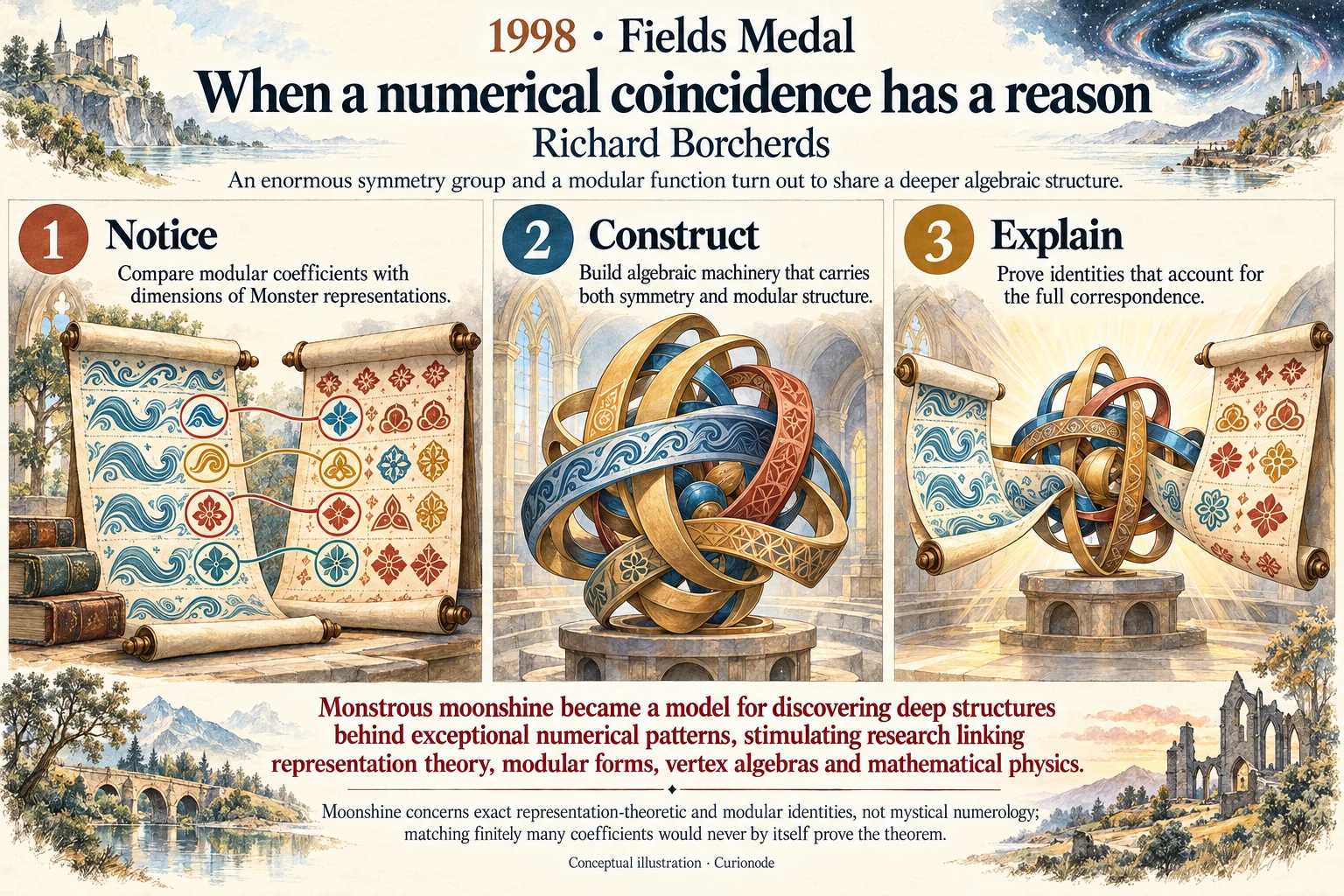
The coefficients of a famous modular function unexpectedly matched dimensions arising from representations of the Monster group. Such a numerical resemblance alone proves nothing: infinitely many coefficients and many symmetry operations must obey exact identities. Borcherds proved that the relationship is structural. Vertex-algebra methods and a generalised Kac–Moody algebra supplied a setting where group representations and modular behaviour could be studied together. The resulting identities explain why the coefficients fit rather than merely checking more of them. The proof connected finite symmetry, infinite-dimensional algebra and complex analysis in a way that transformed the original puzzle.
Why it matters
Monstrous moonshine became a model for discovering deep structures behind exceptional numerical patterns, stimulating research linking representation theory, modular forms, vertex algebras and mathematical physics.