01 · A life in mathematics
The person behind the work
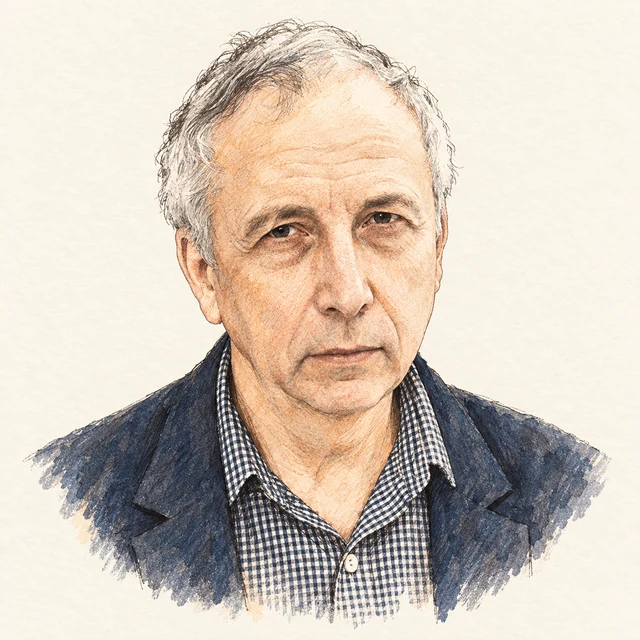
Vladimir Drinfeld was born in Kharkiv, then in the Ukrainian Soviet Socialist Republic, and worked in Kharkiv when he received the 1990 Fields Medal. The award recognised breakthroughs in the Langlands programme and quantum groups. He proved the Langlands correspondence for general linear groups of rank two over function fields, using geometric objects now called Drinfeld modules and shtukas. In another direction, he helped create quantum groups, algebraic structures that deform familiar symmetries and organise tensor products in new ways. These contributions opened distinct but interconnected research programmes in arithmetic, representation theory and mathematical physics. His later Chicago appointment should not be substituted for his award-period institution.
The contribution, explained
Ordinary symmetry groups describe operations such as rotations and how they compose. Their representations turn those operations into linear transformations. Quantum groups generalise this picture by deforming associated algebras while preserving operations that make tensor products of representations meaningful. Exchanging two factors can involve a nontrivial braiding rather than a simple swap. Drinfeld’s ideas gave a systematic language for these structures and their links to integrable systems and knot theory. The parameter of deformation can recover a classical object in a suitable limit. Despite the name, a quantum group is an algebraic object, not simply a collection of quantum particles.
Why it matters
Quantum groups transformed representation theory and supplied new connections among symmetry, integrable models, braided structures and low-dimensional topology, alongside Drinfeld’s separate breakthroughs in arithmetic geometry.