c.curionodeThe Fields Archive

1990 · Algebra & representation

Symmetry can be deformed

Quantum groups change the algebra of symmetry while retaining enough structure to combine representations.

1990Fields Medal
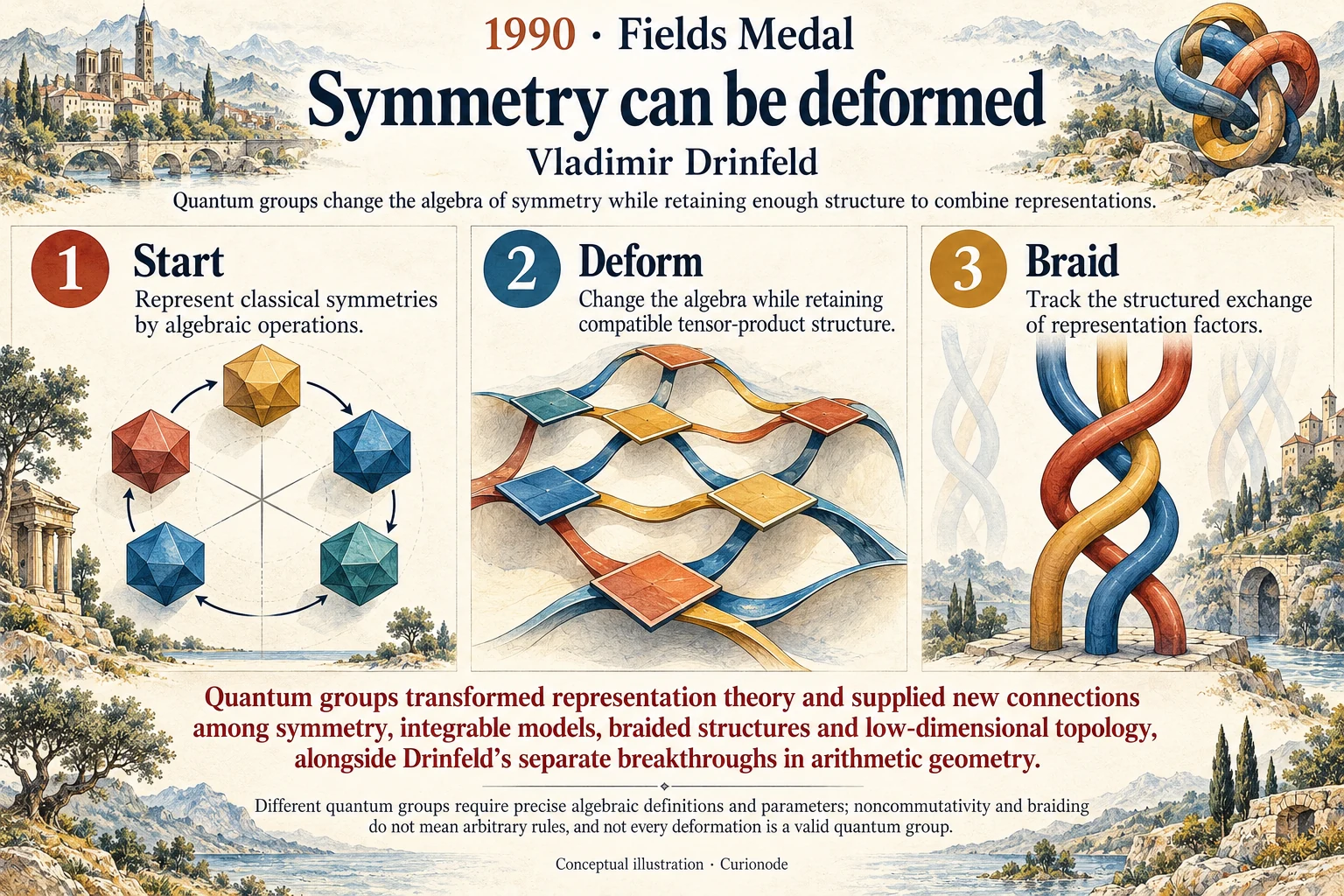
Symmetry can be deformed: Quantum groups change the algebra of symmetry while retaining enough structure to combine representations.
Original AI-generated infographic by Curionode. Read the text version below for the full explanation.
Read the poster text
  1. Start

    Represent classical symmetries by algebraic operations.

  2. Deform

    Change the algebra while retaining compatible tensor-product structure.

  3. Braid

    Track the structured exchange of representation factors.

Quantum groups transformed representation theory and supplied new connections among symmetry, integrable models, braided structures and low-dimensional topology, alongside Drinfeld’s separate breakthroughs in arithmetic geometry.

Different quantum groups require precise algebraic definitions and parameters; noncommutativity and braiding do not mean arbitrary rules, and not every deformation is a valid quantum group.

01 · The idea

In everyday language

Ordinary symmetry groups describe operations such as rotations and how they compose. Their representations turn those operations into linear transformations. Quantum groups generalise this picture by deforming associated algebras while preserving operations that make tensor products of representations meaningful. Exchanging two factors can involve a nontrivial braiding rather than a simple swap. Drinfeld’s ideas gave a systematic language for these structures and their links to integrable systems and knot theory. The parameter of deformation can recover a classical object in a suitable limit. Despite the name, a quantum group is an algebraic object, not simply a collection of quantum particles.

Why it matters

Quantum groups transformed representation theory and supplied new connections among symmetry, integrable models, braided structures and low-dimensional topology, alongside Drinfeld’s separate breakthroughs in arithmetic geometry.
02 · The people

Who brought the idea to life?

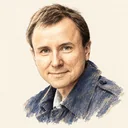
Illustrated portrait of Vladimir Drinfeld

Vladimir Drinfeld

Vladimir Drinfeld was born in Kharkiv, then in the Ukrainian Soviet Socialist Republic, and worked in Kharkiv when he received the 1990 Fields Medal. The award recognised breakthroughs in the Langlands programme and quantum groups. He proved the Langlands correspondence for general linear groups of rank two over function fields, using geometric objects now called Drinfeld modules and shtukas. In another direction, he helped create quantum groups, algebraic structures that deform familiar symmetries and organise tensor products in new ways. These contributions opened distinct but interconnected research programmes in arithmetic, representation theory and mathematical physics. His later Chicago appointment should not be substituted for his award-period institution.

Read the biography ↗

03 · Read further

From the original sources

Original explanations based on the official award record. The subject label is an editorial navigation aid.

  1. Official IMU citation: Vladimir Drinfeld ↗www.mathunion.org
  2. Heidelberg Laureate Forum: Vladimir Drinfeld ↗www.heidelberg-laureate-forum.org
  3. University of Chicago: Drinfeld appointment and mathematical work ↗chronicle.uchicago.edu