c.curionodeThe Fields Archive

1954 · Algebraic geometry

When complex geometry becomes algebraic

Positivity can provide enough global coordinates to place a compact complex manifold inside projective space.

1954Fields Medal
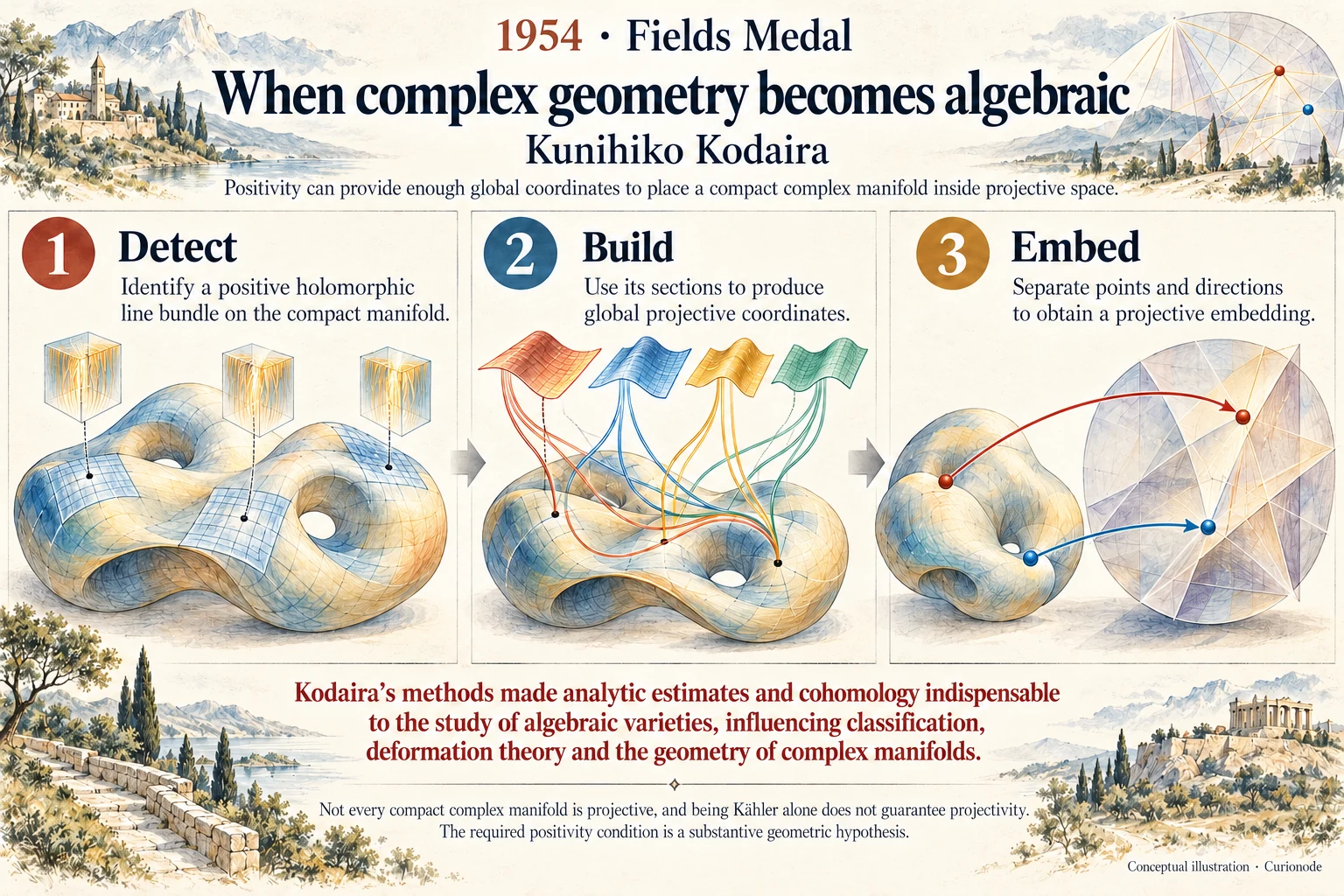
When complex geometry becomes algebraic: Positivity can provide enough global coordinates to place a compact complex manifold inside projective space.
Original AI-generated infographic by Curionode. Read the text version below for the full explanation.
Read the poster text
  1. Detect

    Identify a positive holomorphic line bundle on the compact manifold.

  2. Build

    Use its sections to produce global projective coordinates.

  3. Embed

    Separate points and directions to obtain a projective embedding.

Kodaira’s methods made analytic estimates and cohomology indispensable to the study of algebraic varieties, influencing classification, deformation theory and the geometry of complex manifolds.


Not every compact complex manifold is projective, and being Kähler alone does not guarantee projectivity. The required positivity condition is a substantive geometric hypothesis.

01 · The idea

In everyday language

A complex manifold is described locally by complex coordinates, but these charts need not come from one global system of polynomial equations. Kodaira’s embedding theorem gives a powerful criterion: a compact complex manifold carrying a positive holomorphic line bundle can be embedded in complex projective space. Sections of sufficiently high powers of the bundle supply the coordinates, while analytic estimates ensure there are enough sections to distinguish points and directions. The result builds a bridge from analytic positivity to projective algebraic geometry, revealing when two descriptions of a space genuinely coincide.

Why it matters

Kodaira’s methods made analytic estimates and cohomology indispensable to the study of algebraic varieties, influencing classification, deformation theory and the geometry of complex manifolds.

02 · The people

Who brought the idea to life?

Illustrated portrait of Kunihiko Kodaira

Kunihiko Kodaira

Kunihiko Kodaira was born in Tokyo in 1915 and worked across complex analysis, geometry and the theory of algebraic varieties. His 1954 Fields Medal recognised results involving harmonic integrals and their applications to complex and algebraic manifolds. He was then based at Princeton University. A recurring theme of his mathematics was the passage between analytic information, such as differential forms and positivity, and geometric descriptions by equations. His embedding and vanishing theorems became central tools, helping explain when a complex geometric object can be placed inside projective space.

Read the biography ↗

03 · Read further

From the original sources

Original explanations based on the official award record. The subject label is an editorial navigation aid.

  1. Official IMU citation: Kunihiko Kodaira ↗www.mathunion.org
  2. Heidelberg Laureate Forum: Kunihiko Kodaira ↗www.heidelberg-laureate-forum.org
  3. Mathematical Society of Japan: Kodaira centennial and works ↗mathsoc.jp