c.curionodeThe Fields Archive

1970 · Algebraic geometry

Replacing a singular space with a smooth model

Carefully chosen modifications can separate geometric behaviour that has become tangled at singular points.

1970Fields Medal
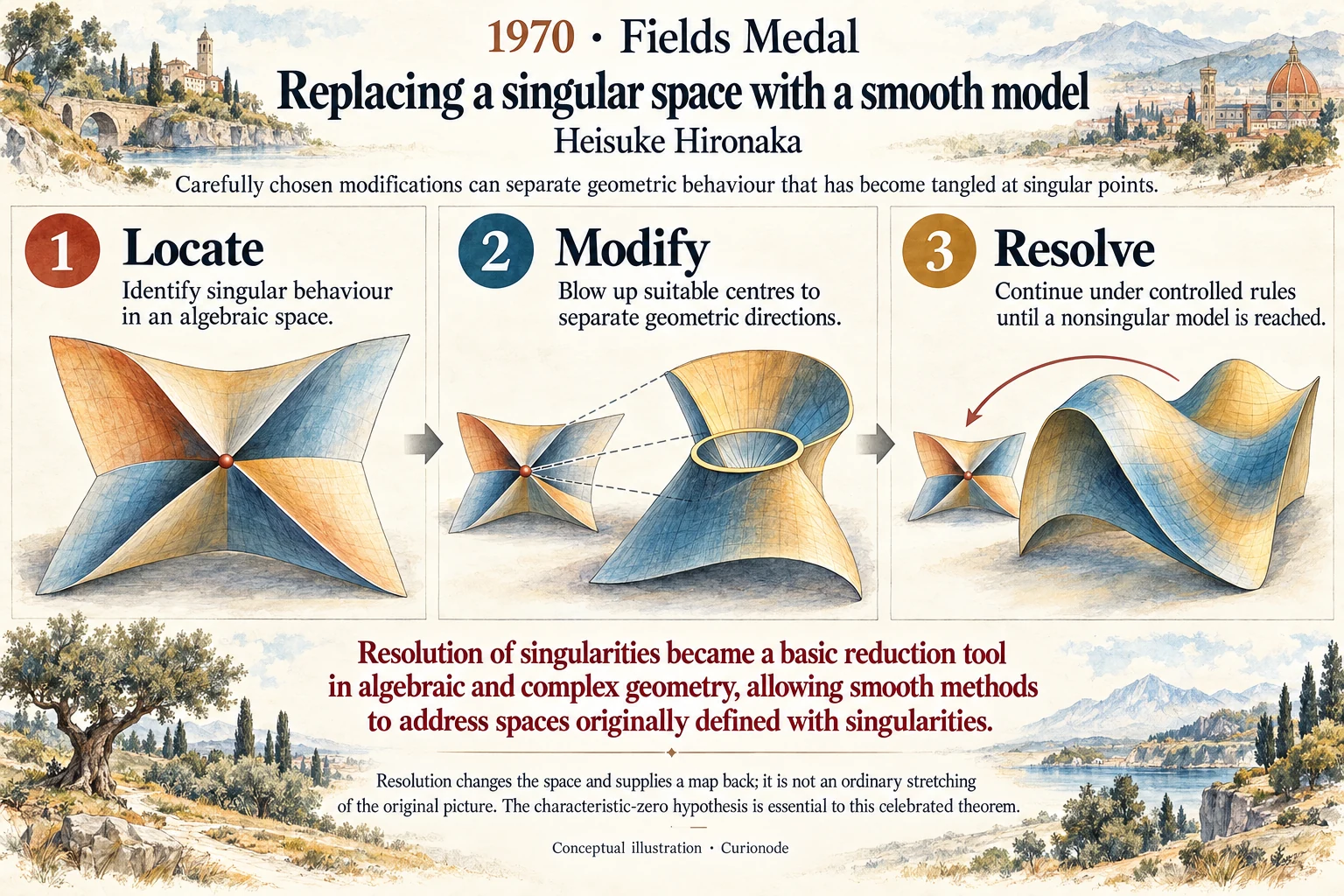
Replacing a singular space with a smooth model: Carefully chosen modifications can separate geometric behaviour that has become tangled at singular points.
Original AI-generated infographic by Curionode. Read the text version below for the full explanation.
Read the poster text
  1. Locate

    Identify singular behaviour in an algebraic space.

  2. Modify

    Blow up suitable centres to separate geometric directions.

  3. Resolve

    Continue under controlled rules until a nonsingular model is reached.

Resolution of singularities became a basic reduction tool in algebraic and complex geometry, allowing smooth methods to address spaces originally defined with singularities.

Resolution changes the space and supplies a map back; it is not an ordinary stretching of the original picture. The characteristic-zero hypothesis is essential to this celebrated theorem.

01 · The idea

In everyday language

A polynomial equation may define a space with a crossing, cusp or more complicated singularity. A blow-up replaces a chosen centre with extra geometric information that separates directions previously merged there. One modification need not finish the job: the challenge is choosing centres and proving that a controlled sequence eventually produces a nonsingular model. Hironaka established this in characteristic zero and arbitrary dimension. Away from the singular region, the construction preserves the intended birational relationship, providing a smooth space mapped back to the original rather than simply erasing the troublesome points.

Why it matters

Resolution of singularities became a basic reduction tool in algebraic and complex geometry, allowing smooth methods to address spaces originally defined with singularities.

02 · The people

Who brought the idea to life?

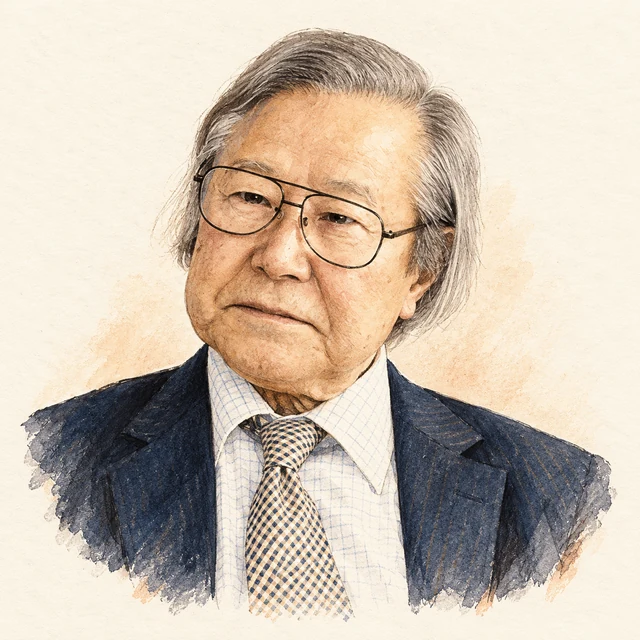
Illustrated portrait of Heisuke Hironaka

Heisuke Hironaka

Heisuke Hironaka was born in Yū, now part of Iwakuni in Japan, in 1931. His 1970 Fields Medal recognised the resolution of singularities of algebraic varieties in characteristic zero, proved in arbitrary dimension. He was then a professor at Harvard. The theorem showed that singular geometric objects could be related systematically to nonsingular ones through carefully chosen modifications. Hironaka’s achievement became a foundational tool in algebraic geometry and complex geometry, enabling arguments that replace difficult singular spaces with smoother spaces while retaining a controlled relationship to the original object.

Read the biography ↗

03 · Read further

From the original sources

Original explanations based on the official award record. The subject label is an editorial navigation aid.

  1. Official IMU citation: Heisuke Hironaka ↗www.mathunion.org
  2. Heidelberg Laureate Forum: Heisuke Hironaka ↗www.heidelberg-laureate-forum.org
  3. Harvard Mathematics: Heisuke Hironaka memorial ↗www.math.harvard.edu