c.curionodeThe Fields Archive

1978 · Analysis & PDEs

When dimension changes the rules

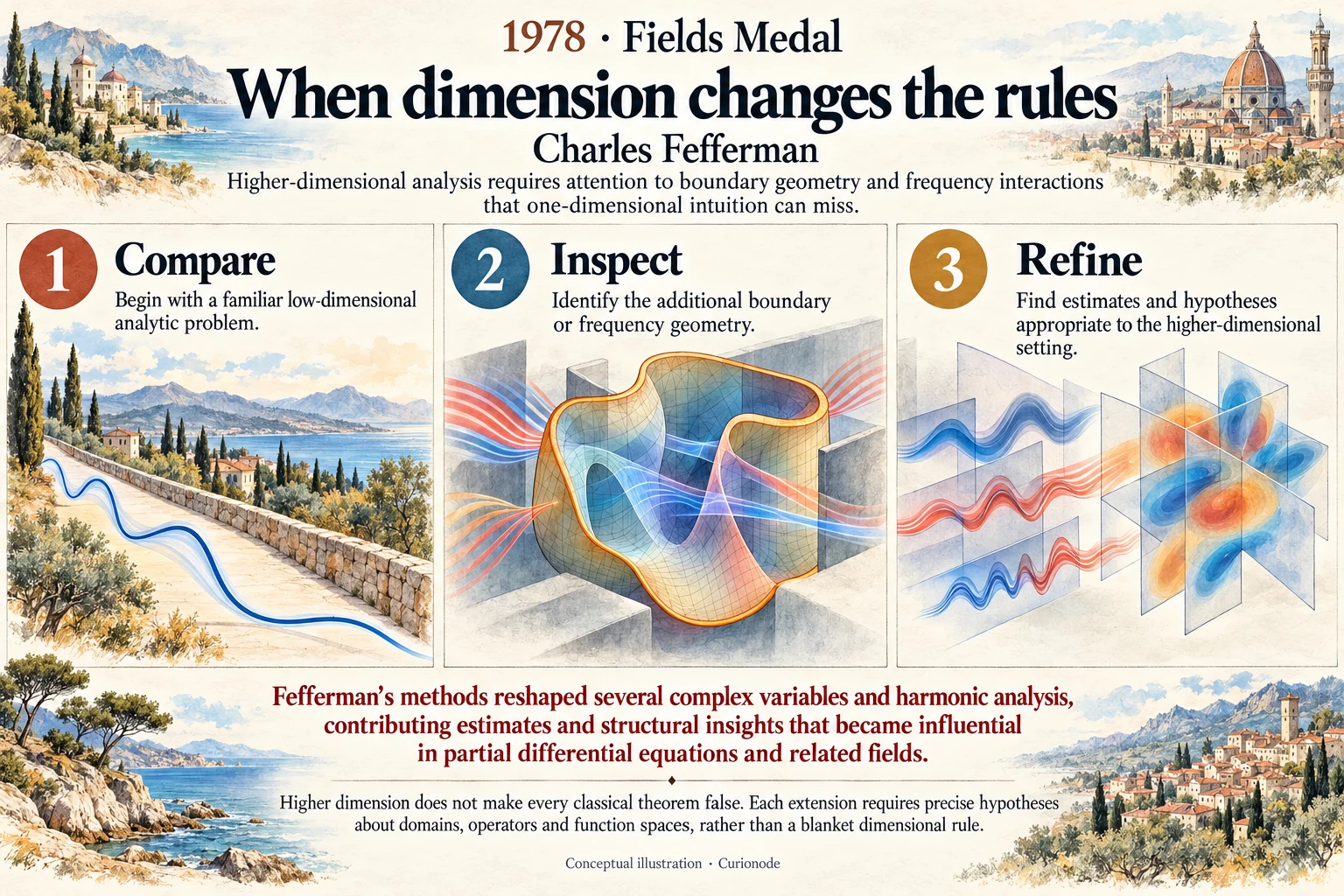
Higher-dimensional analysis requires attention to boundary geometry and frequency interactions that one-dimensional intuition can miss.

1978Fields Medal
When dimension changes the rules: Higher-dimensional analysis requires attention to boundary geometry and frequency interactions that one-dimensional intuition can miss.
Original AI-generated infographic by Curionode. Read the text version below for the full explanation.
Read the poster text
  1. Compare

    Begin with a familiar low-dimensional analytic problem.

  2. Inspect

    Identify the additional boundary or frequency geometry.

  3. Refine

    Find estimates and hypotheses appropriate to the higher-dimensional setting.

Fefferman’s methods reshaped several complex variables and harmonic analysis, contributing estimates and structural insights that became influential in partial differential equations and related fields.


Higher dimension does not make every classical theorem false. Each extension requires precise hypotheses about domains, operators and function spaces, rather than a blanket dimensional rule.

01 · The idea

In everyday language

Many familiar analytic results begin with functions of one real or complex variable. In several variables, the geometry of a domain and the interaction of different directions can become decisive. Fefferman developed powerful methods for recognising which classical intuitions extend and which break down. In complex analysis, the boundary geometry of domains governs important analytic behaviour; in harmonic analysis, the shape of frequency regions can alter boundedness properties. These themes show why replacing a line with a multidimensional space is not simply adding more coordinates. The correct generalisation must respect the geometry that the new setting introduces.

Why it matters

Fefferman’s methods reshaped several complex variables and harmonic analysis, contributing estimates and structural insights that became influential in partial differential equations and related fields.

02 · The people

Who brought the idea to life?

Illustrated portrait of Charles Fefferman

Charles Fefferman

Charles Fefferman was born in Washington, D.C., in 1949. He earned his doctorate at Princeton, worked at Chicago and returned to the Princeton faculty in 1973. His 1978 Fields Medal recognised profound contributions to analysis, including several complex variables and related operator problems. He repeatedly discovered that familiar low-dimensional intuitions require new geometric and analytic tools in higher dimensions. His research ranges across harmonic analysis, partial differential equations and complex geometry, with a characteristic emphasis on precise estimates that explain both the possibilities and the limits of generalisation.

Read the biography ↗

03 · Read further

From the original sources

Original explanations based on the official award record. The subject label is an editorial navigation aid.

  1. Official IMU citation: Charles Fefferman ↗www.mathunion.org
  2. Heidelberg Laureate Forum: Charles Fefferman ↗www.heidelberg-laureate-forum.org
  3. Princeton: Fefferman research and appointment chronology ↗www.princeton.edu