c.curionodeThe Fields Archive

2026 · Analysis & PDEs

From colliding particles to a gas equation

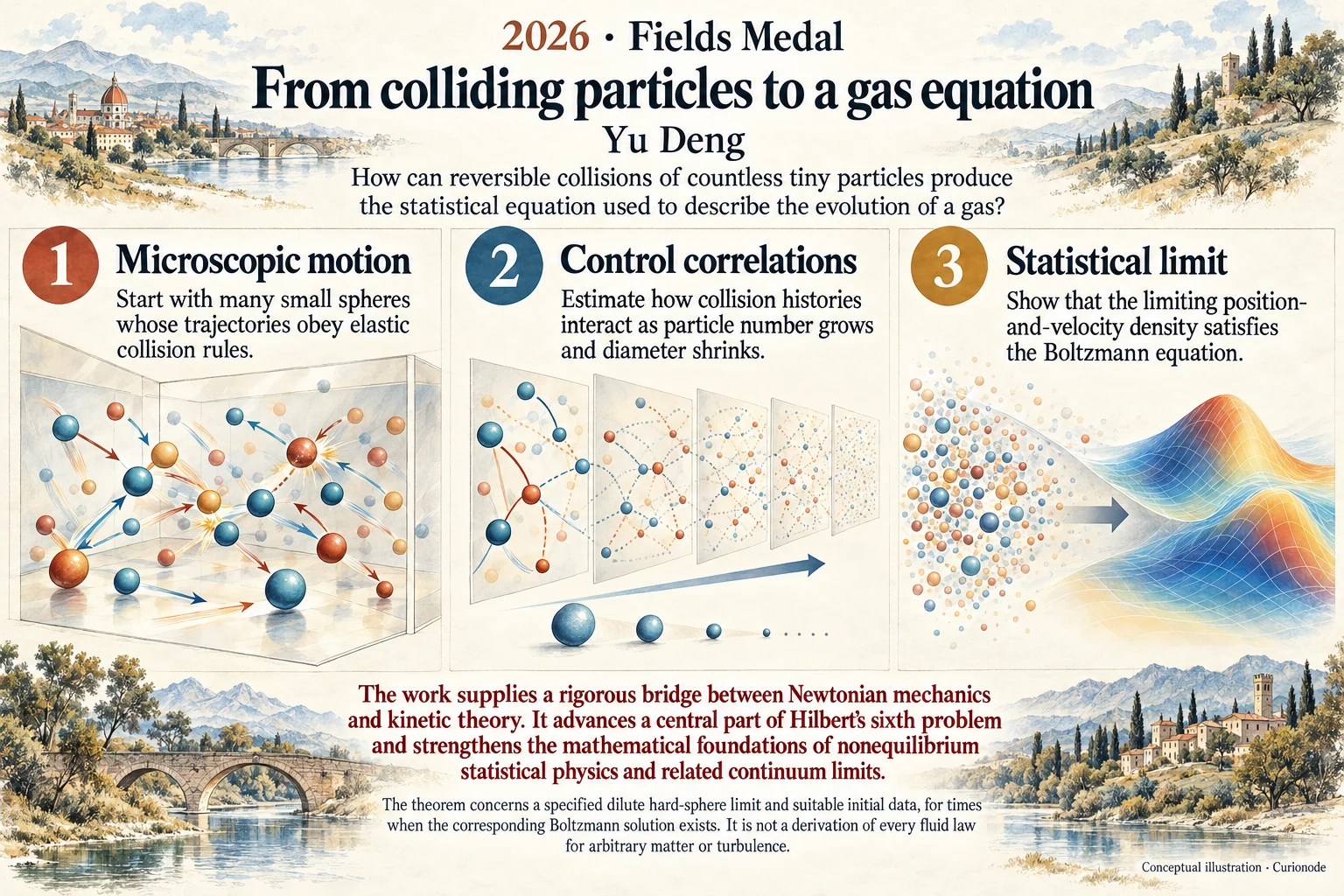
How can reversible collisions of countless tiny particles produce the statistical equation used to describe the evolution of a gas?

2026Fields Medal
From colliding particles to a gas equation: How can reversible collisions of countless tiny particles produce the statistical equation used to describe the evolution of a gas?
Original AI-generated infographic by Curionode. Read the text version below for the full explanation.
Read the poster text
  1. Microscopic motion

    Start with many small spheres whose trajectories obey elastic collision rules.

  2. Control correlations

    Estimate how collision histories interact as particle number grows and diameter shrinks.

  3. Statistical limit

    Show that the limiting position-and-velocity density satisfies the Boltzmann equation.

The work supplies a rigorous bridge between Newtonian mechanics and kinetic theory. It advances a central part of Hilbert’s sixth problem and strengthens the mathematical foundations of nonequilibrium statistical physics and related continuum limits.


The theorem concerns a specified dilute hard-sphere limit and suitable initial data, for times when the corresponding Boltzmann solution exists. It is not a derivation of every fluid law for arbitrary matter or turbulence.

01 · The idea

In everyday language

Following every molecule of a gas is hopeless in practice. The Boltzmann equation instead tracks a density: how many particles have a given position and velocity. But a useful equation should also follow from an underlying model. Deng, Hani and Ma studied many small hard spheres moving by Newtonian rules and colliding elastically. In an appropriate low-density limit, they controlled the accumulation of correlations created by repeated collisions and derived the Boltzmann description on long time intervals. This connects two mathematical levels of explanation: exact particle trajectories and the evolving statistical distribution of a gas.

Why it matters

The work supplies a rigorous bridge between Newtonian mechanics and kinetic theory. It advances a central part of Hilbert’s sixth problem and strengthens the mathematical foundations of nonequilibrium statistical physics and related continuum limits.

02 · The people

Who brought the idea to life?

Illustrated portrait of Yu Deng

Yu Deng

Yu Deng is an analyst born in Shenzhen whose research connects deterministic differential equations with statistical descriptions of large systems. After undergraduate study at Peking University and MIT, he earned his doctorate at Princeton in 2015. At the time of the 2026 medal he was a professor at the University of Chicago. With Zaher Hani and Xiao Ma, he derived the Boltzmann equation from hard-sphere dynamics in a dilute-gas limit. His collaborations also developed wave kinetic limits and probabilistic methods for nonlinear Schrödinger equations. These results clarify when collective laws follow rigorously from microscopic motion.

Read the biography ↗

03 · Read further

From the original sources

Original explanations based on the official award record. The subject label is an editorial navigation aid.

  1. Official IMU citation: Yu Deng ↗www.mathunion.org
  2. Heidelberg Laureate Forum: Yu Deng ↗www.heidelberg-laureate-forum.org
  3. University of Chicago: Yu Deng receives the 2026 Fields Medal ↗news.uchicago.edu
  4. Peking University: 王虹、邓煜获奖及教育经历 ↗news.pku.edu.cn
  5. IMU: Yu Deng detailed citation ↗www.mathunion.org