c.curionodeThe Fields Archive

1986 · Number theory

When a curve has only finitely many rational points

The geometry of a curve can force a finite answer to an arithmetic question about equations.

1986Fields Medal
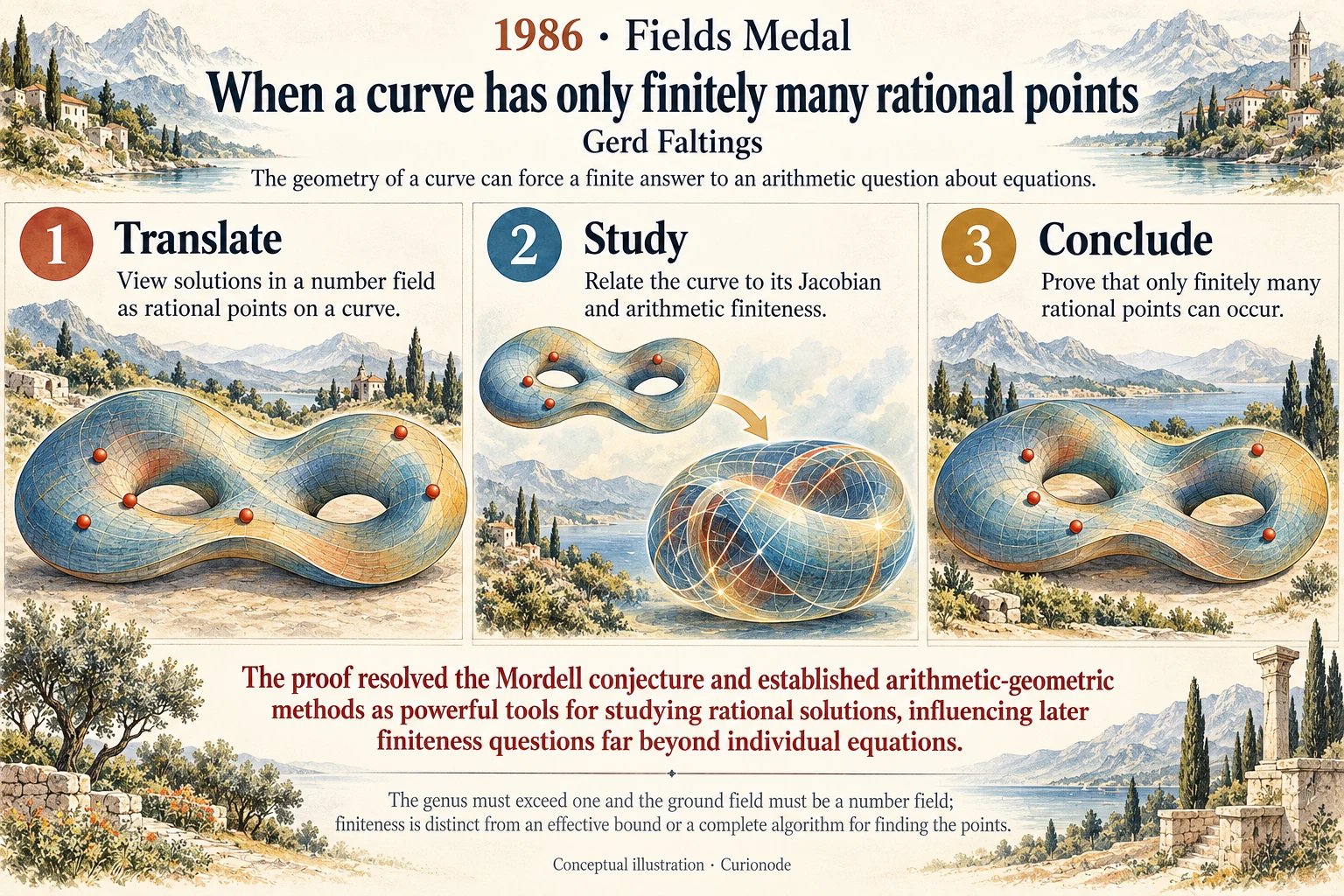
When a curve has only finitely many rational points: The geometry of a curve can force a finite answer to an arithmetic question about equations.
Original AI-generated infographic by Curionode. Read the text version below for the full explanation.
Read the poster text
  1. Translate

    View solutions in a number field as rational points on a curve.

  2. Study

    Relate the curve to its Jacobian and arithmetic finiteness.

  3. Conclude

    Prove that only finitely many rational points can occur.

The proof resolved the Mordell conjecture and established arithmetic-geometric methods as powerful tools for studying rational solutions, influencing later finiteness questions far beyond individual equations.


The genus must exceed one and the ground field must be a number field; finiteness is distinct from an effective bound or a complete algorithm for finding the points.

01 · The idea

In everyday language

A rational point on a curve is a solution whose coordinates lie in the chosen number field. Curves behave differently according to their genus: some have infinitely many rational points, while sufficiently complicated ones do not. Faltings proved that every smooth projective curve of genus greater than one over a number field has only finitely many such points. His approach studies the curve’s Jacobian and finiteness properties of abelian varieties, bringing geometry and arithmetic together. The theorem rules out an endless supply of solutions without necessarily showing where the last one lies or giving an effective search bound.

Why it matters

The proof resolved the Mordell conjecture and established arithmetic-geometric methods as powerful tools for studying rational solutions, influencing later finiteness questions far beyond individual equations.

02 · The people

Who brought the idea to life?

Illustrated portrait of Gerd Faltings

Gerd Faltings

Gerd Faltings was born in Gelsenkirchen-Buer in what was then West Germany and was a Princeton professor when he received the 1986 Fields Medal. His proof of the Mordell conjecture established that a smooth projective curve of genus greater than one over a number field has only finitely many rational points over that field. The proof connected curves with their Jacobian abelian varieties and deep finiteness theorems in arithmetic geometry. It transformed a question about solving equations into one about the organisation of geometric objects. Faltings’ result proves finiteness; it does not, by itself, provide a general algorithm that lists every point.

Read the biography ↗

03 · Read further

From the original sources

Original explanations based on the official award record. The subject label is an editorial navigation aid.

  1. Official IMU citation: Gerd Faltings ↗www.mathunion.org
  2. Heidelberg Laureate Forum: Gerd Faltings ↗www.heidelberg-laureate-forum.org
  3. Max Planck Society: Gerd Faltings ↗www.mpg.de