c.curionodeThe Fields Archive

1994 · Probability & dynamics

When irregular motion is a disguised rotation

Changing coordinates can reveal a regular rotation beneath a circle map, but arithmetic controls when this works smoothly.

1994Fields Medal
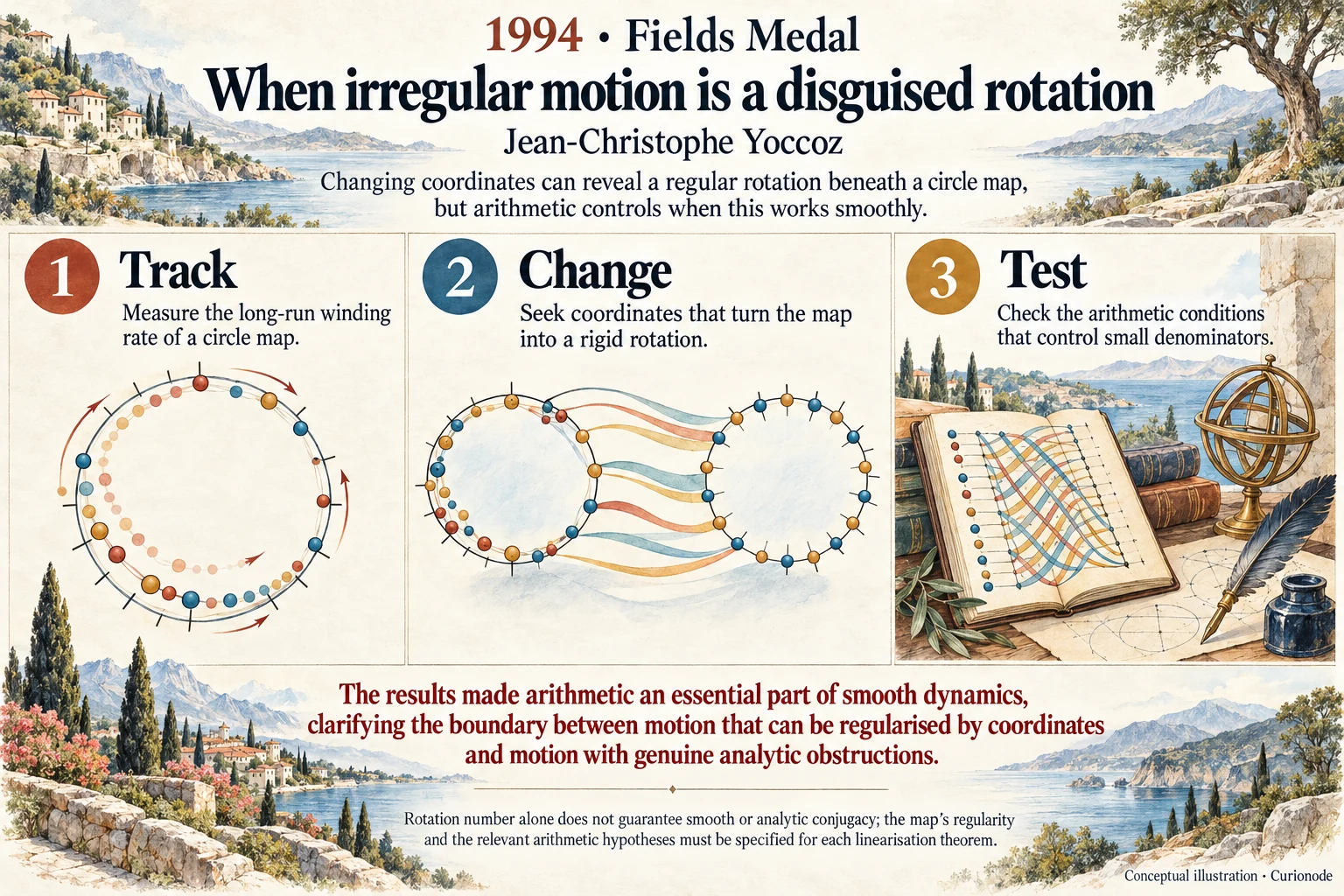
When irregular motion is a disguised rotation: Changing coordinates can reveal a regular rotation beneath a circle map, but arithmetic controls when this works smoothly.
Original AI-generated infographic by Curionode. Read the text version below for the full explanation.
Read the poster text
  1. Track

    Measure the long-run winding rate of a circle map.

  2. Change

    Seek coordinates that turn the map into a rigid rotation.

  3. Test

    Check the arithmetic conditions that control small denominators.

The results made arithmetic an essential part of smooth dynamics, clarifying the boundary between motion that can be regularised by coordinates and motion with genuine analytic obstructions.


Rotation number alone does not guarantee smooth or analytic conjugacy; the map’s regularity and the relevant arithmetic hypotheses must be specified for each linearisation theorem.

01 · The idea

In everyday language

Imagine a rule that moves every point around a circle while preserving orientation. Its rotation number records the average winding rate under repeated application. For an irrational rotation number there are no periodic orbits, yet this does not guarantee a smooth change of coordinates to a uniform rotation. Very close rational approximations create small-denominator difficulties in the equations defining such a change. Yoccoz established sharp results showing how arithmetic conditions and regularity determine linearisation. His work explains why two rotation numbers that look similarly irrational can lead to substantially different analytic behaviour.

Why it matters

The results made arithmetic an essential part of smooth dynamics, clarifying the boundary between motion that can be regularised by coordinates and motion with genuine analytic obstructions.

02 · The people

Who brought the idea to life?

Illustrated portrait of Jean-Christophe Yoccoz

Jean-Christophe Yoccoz

Jean-Christophe Yoccoz was born in Paris and worked at Université Paris-Sud when he received the 1994 Fields Medal. He studied how repeated transformations generate stable, periodic or intricate behaviour. His contributions to circle diffeomorphisms clarified when a complicated motion can be transformed into a rigid rotation by a change of coordinates. He also developed powerful methods in complex dynamics, including puzzle constructions for studying polynomial maps and parts of the Mandelbrot set. His work made arithmetic properties of rotation numbers central to questions of smoothness and stability. It did not settle local connectivity of the entire Mandelbrot set, a broader problem than his celebrated results.

Read the biography ↗

03 · Read further

From the original sources

Original explanations based on the official award record. The subject label is an editorial navigation aid.

  1. Official IMU citation: Jean-Christophe Yoccoz ↗www.mathunion.org
  2. Heidelberg Laureate Forum: Jean-Christophe Yoccoz ↗www.heidelberg-laureate-forum.org
  3. Collège de France: Jean-Christophe Yoccoz ↗www.college-de-france.fr