c.curionodeThe Fields Archive

2014 · Probability & dynamics

Changing scale to understand repeated motion

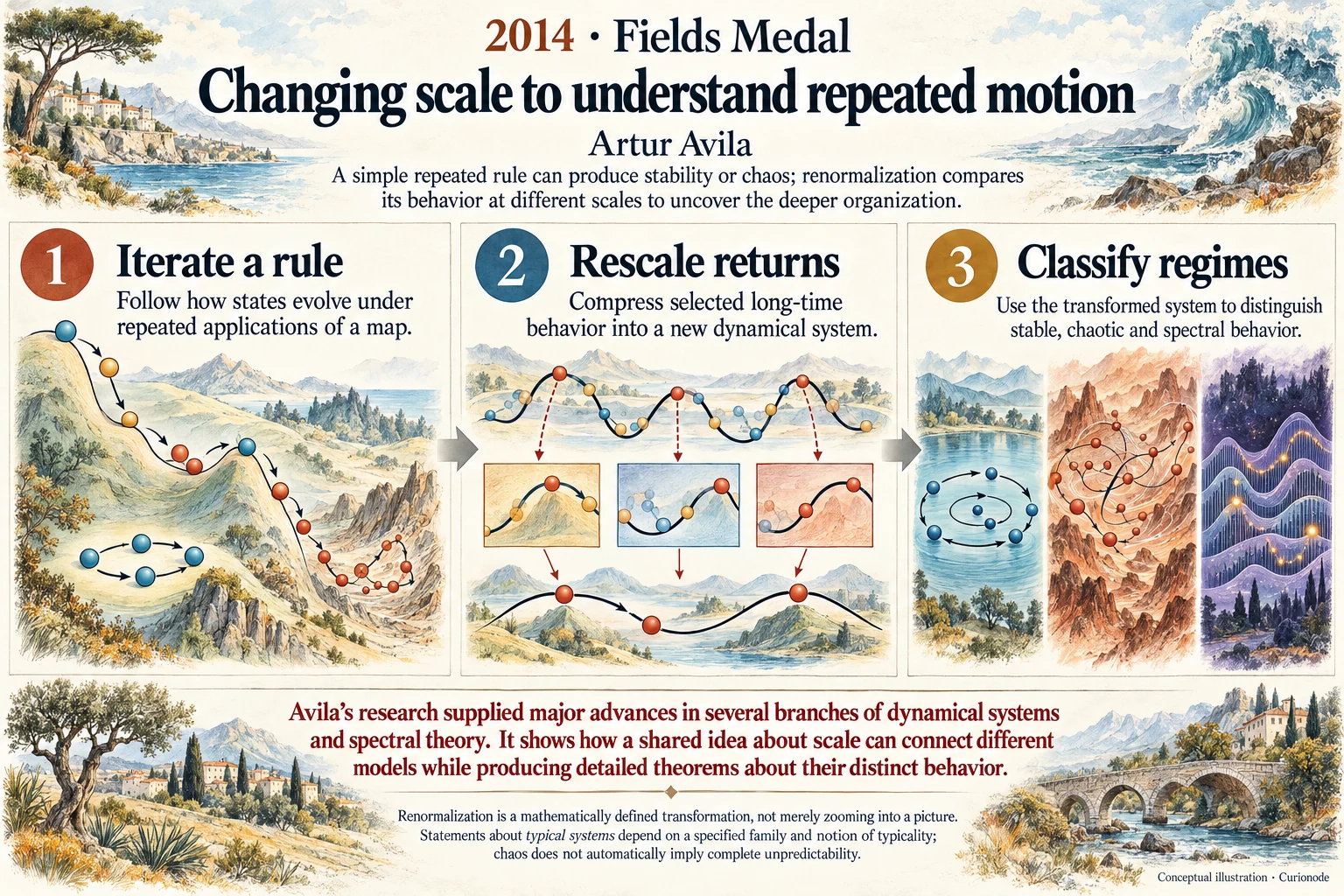
A simple repeated rule can produce stability or chaos; renormalization compares its behavior at different scales to uncover the deeper organization.

2014Fields Medal
Changing scale to understand repeated motion: A simple repeated rule can produce stability or chaos; renormalization compares its behavior at different scales to uncover the deeper organization.
Original AI-generated infographic by Curionode. Read the text version below for the full explanation.
Read the poster text
  1. Iterate a rule

    Follow how states evolve under repeated applications of a map.

  2. Rescale returns

    Compress selected long-time behavior into a new dynamical system.

  3. Classify regimes

    Use the transformed system to distinguish stable, chaotic and spectral behavior.

Avila’s research supplied major advances in several branches of dynamical systems and spectral theory. It shows how a shared idea about scale can connect different models while producing detailed theorems about their distinct behavior.


Renormalization is a mathematically defined transformation, not merely zooming into a picture. Statements about typical systems depend on a specified family and notion of typicality; chaos does not automatically imply complete unpredictability.

01 · The idea

In everyday language

A dynamical system starts with a state and repeatedly applies a rule. Even a map of an interval can produce periodic cycles, sensitive dependence and complicated statistical behavior. Renormalization studies selected returns and rescales them, replacing a long piece of motion with a new system that may be easier to understand. Avila used this idea across several areas, including one-dimensional dynamics, interval exchanges and quasiperiodic operators. Rather than assuming all complicated behavior is the same, his work identifies which regimes occur in precisely specified families and how transitions between them work. Rescaling becomes a tool for proving classification and stability results.

Why it matters

Avila’s research supplied major advances in several branches of dynamical systems and spectral theory. It shows how a shared idea about scale can connect different models while producing detailed theorems about their distinct behavior.

02 · The people

Who brought the idea to life?

Illustrated portrait of Artur Avila

Artur Avila

Artur Avila was born in Rio de Janeiro and earned his doctorate at IMPA in 2001 under Welington de Melo. At his 2014 Fields Medal he held research appointments at IMPA and the CNRS in Paris. His work in dynamical systems uses renormalization to compare behavior across scales. With collaborators he resolved major questions about one-dimensional dynamics, interval exchanges and quasiperiodic Schrödinger operators, including the Ten Martini Problem. His results distinguish stable patterns from chaotic behavior in precisely defined families. This combination of statistical, analytic and geometric thinking reshaped how mathematicians study systems generated by repeated application of a rule.

Read the biography ↗

03 · Read further

From the original sources

Original explanations based on the official award record. The subject label is an editorial navigation aid.

  1. Official IMU citation: Artur Avila ↗www.mathunion.org
  2. Heidelberg Laureate Forum: Artur Avila ↗www.heidelberg-laureate-forum.org
  3. IMU: Artur Avila work and corrected 2014 institutional affiliations ↗www.mathunion.org
  4. CNRS: Artur Avila, médaille Fields 2014 ↗lejournal.cnrs.fr