c.curionodeThe Fields Archive

1998 · Analysis & PDEs

Two possibilities inside infinite-dimensional space

Combinatorial reasoning reveals a sharp structural alternative within every infinite-dimensional Banach space.

1998Fields Medal
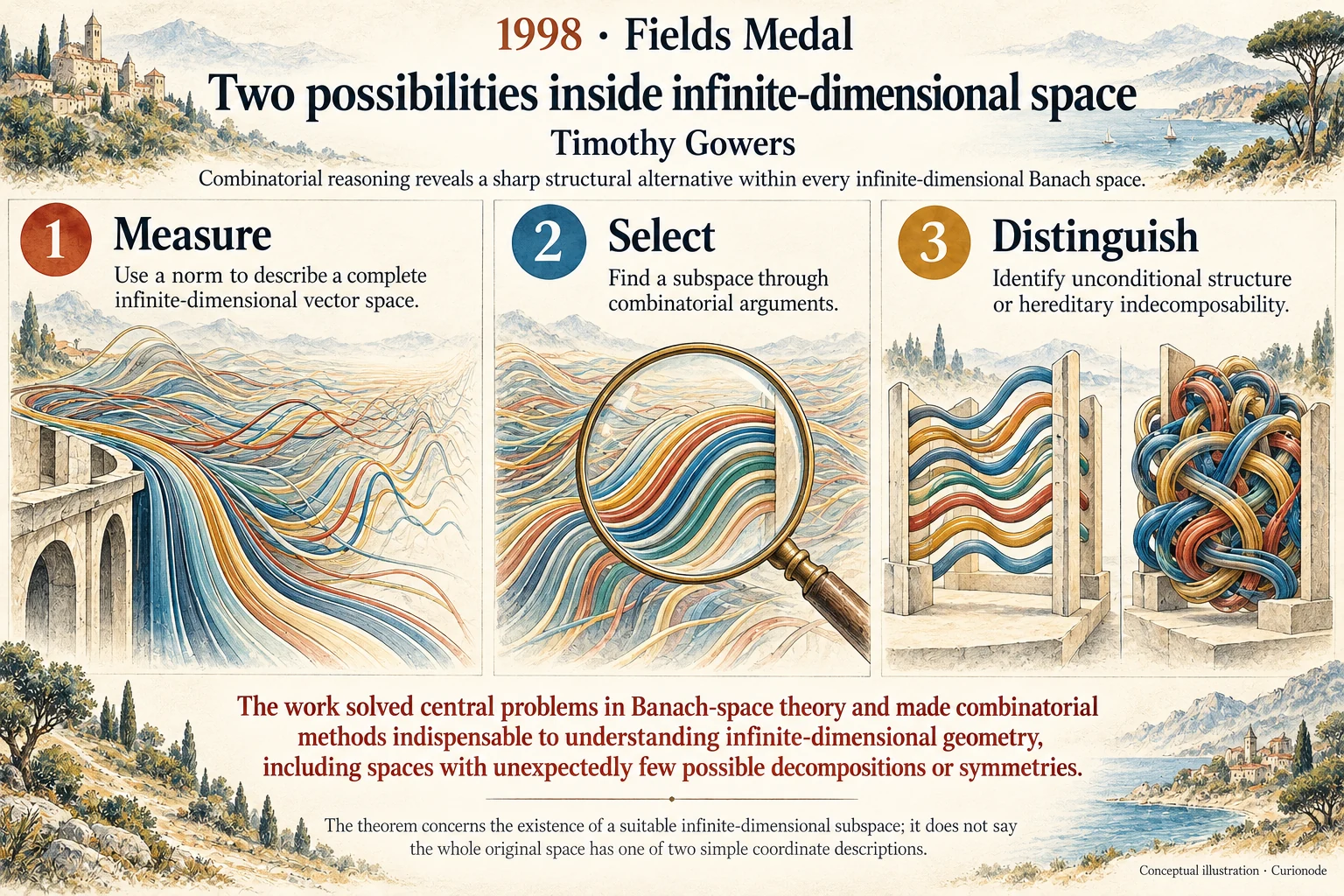
Two possibilities inside infinite-dimensional space: Combinatorial reasoning reveals a sharp structural alternative within every infinite-dimensional Banach space.
Original AI-generated infographic by Curionode. Read the text version below for the full explanation.
Read the poster text
  1. Measure

    Use a norm to describe a complete infinite-dimensional vector space.

  2. Select

    Find a subspace through combinatorial arguments.

  3. Distinguish

    Identify unconditional structure or hereditary indecomposability.

The work solved central problems in Banach-space theory and made combinatorial methods indispensable to understanding infinite-dimensional geometry, including spaces with unexpectedly few possible decompositions or symmetries.


The theorem concerns the existence of a suitable infinite-dimensional subspace; it does not say the whole original space has one of two simple coordinate descriptions.

01 · The idea

In everyday language

A Banach space is a vector space with a complete notion of length; its vectors may encode functions rather than ordinary arrows. Finite-dimensional intuition suggests choosing coordinates and splitting a space into simpler pieces. Gowers showed how dramatically this intuition can fail. His dichotomy finds either a subspace with an unconditional basis, whose convergent expansions tolerate changes of signs, or a hereditarily indecomposable subspace, none of whose infinite-dimensional subspaces splits into two infinite-dimensional closed pieces. Combinatorial selection arguments uncover this alternative. The conclusion organises possible subspaces rather than declaring all Banach spaces equivalent or easily classifiable.

Why it matters

The work solved central problems in Banach-space theory and made combinatorial methods indispensable to understanding infinite-dimensional geometry, including spaces with unexpectedly few possible decompositions or symmetries.

02 · The people

Who brought the idea to life?

Illustrated portrait of Timothy Gowers

Timothy Gowers

Timothy Gowers was born in Wiltshire, England, and was working at Cambridge when he received the 1998 Fields Medal. His research brought combinatorial reasoning into the geometry of infinite-dimensional Banach spaces, resolving longstanding questions about their subspaces and symmetries. His dichotomy theorem showed that every infinite-dimensional Banach space contains a subspace with an unconditional basis or a hereditarily indecomposable subspace. With Bernard Maurey, he constructed spaces that defeated earlier expectations about decompositions. His work also developed powerful connections with combinatorics. The unifying theme is that infinite-dimensional geometry contains both highly regular structures and strikingly rigid counterexamples.

Read the biography ↗

03 · Read further

From the original sources

Original explanations based on the official award record. The subject label is an editorial navigation aid.

  1. Official IMU citation: Timothy Gowers ↗www.mathunion.org
  2. Heidelberg Laureate Forum: Timothy Gowers ↗www.heidelberg-laureate-forum.org
  3. Gowers: An infinite Ramsey theorem and some Banach-space dichotomies ↗annals.math.princeton.edu