01 · The idea
In everyday language
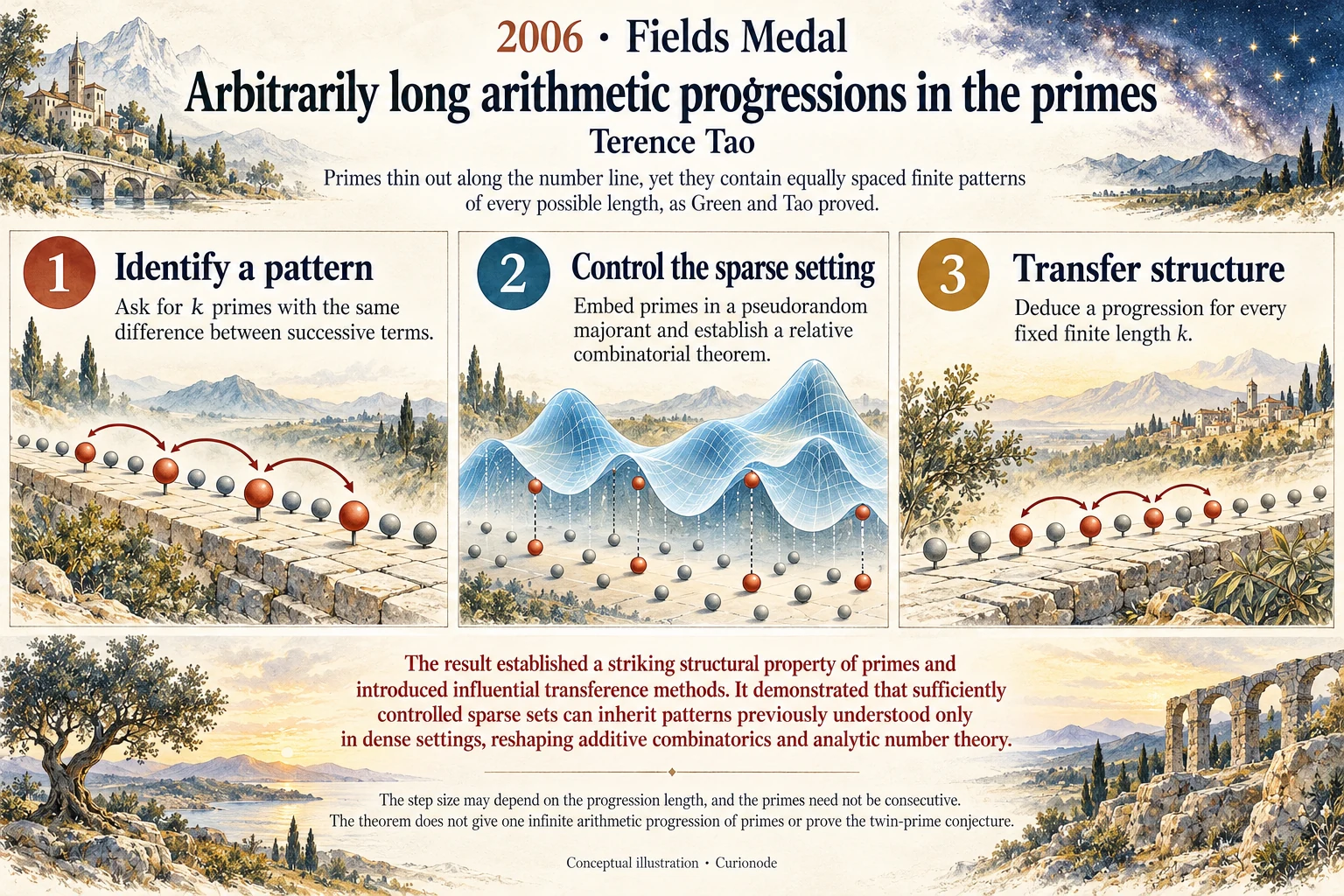
An arithmetic progression has a fixed step, such as 5, 11, 17, 23, where every entry is prime. Green and Tao proved that prime progressions exist with any prescribed finite number of terms. Szemerédi’s theorem already guaranteed long progressions in sets with positive density, but primes have density zero. Their solution placed the primes inside a suitable pseudorandom majorant and developed a relative form of the dense-set argument. This transferred combinatorial structure into a sparse arithmetic setting. The theorem is one example of Tao’s wider achievement in connecting harmonic analysis, combinatorics, partial differential equations and number theory.
Why it matters
The result established a striking structural property of primes and introduced influential transference methods. It demonstrated that sufficiently controlled sparse sets can inherit patterns previously understood only in dense settings, reshaping additive combinatorics and analytic number theory.