01 · The idea
In everyday language
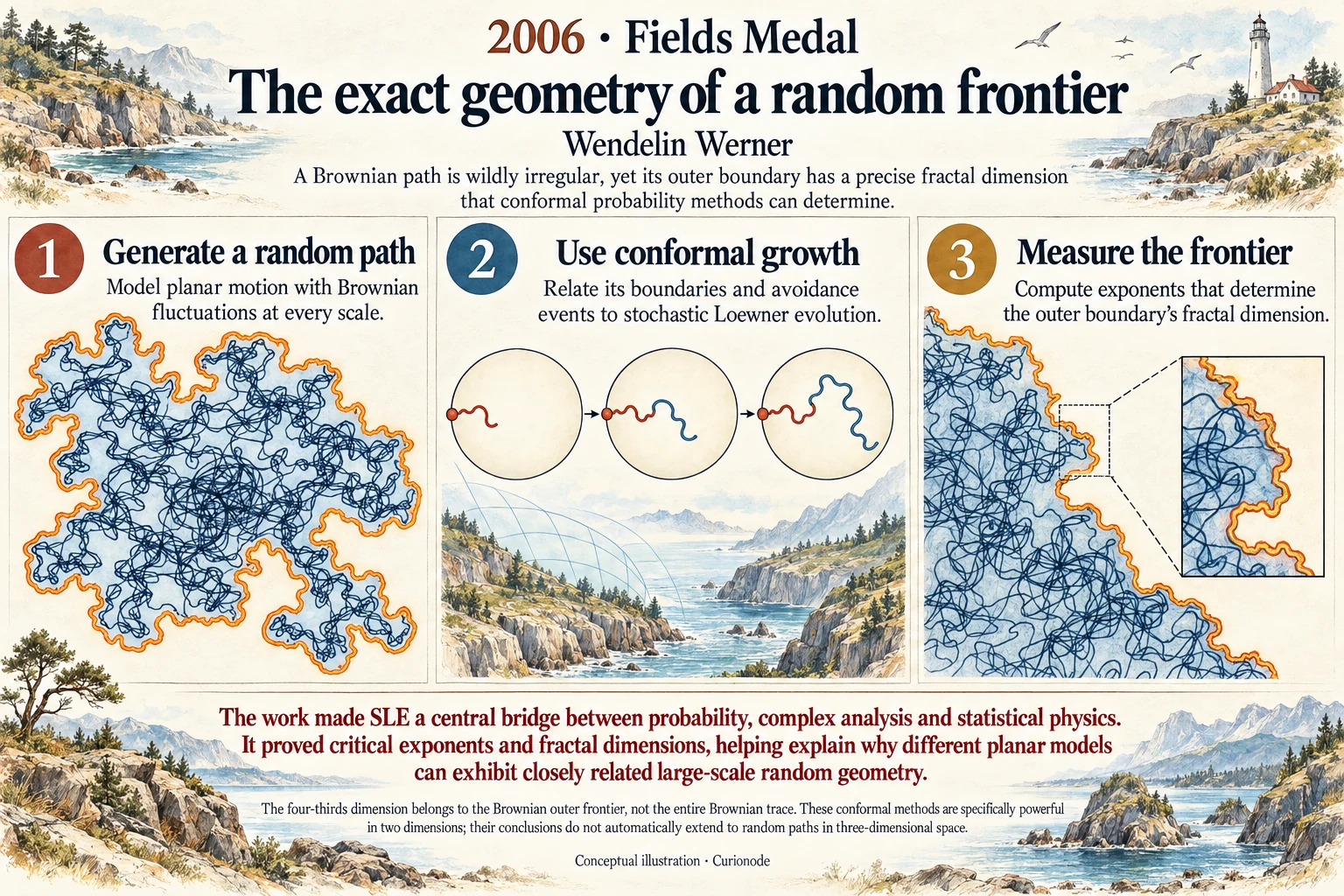
Planar Brownian motion is an idealized random path with fluctuations at every scale. Its full trace has Hausdorff dimension two, but the frontier seen from outside is thinner. Physicists predicted that this outer boundary has dimension four-thirds. Werner, Gregory Lawler and Oded Schramm used conformal methods and stochastic Loewner evolution to prove the prediction. SLE describes growing random curves by conformal maps driven by a one-dimensional Brownian motion. By linking this tractable description to planar probability, they computed intersection exponents and derived exact geometric information. The achievement showed that random fractals can obey rigorous quantitative laws despite their endlessly complicated appearance.
Why it matters
The work made SLE a central bridge between probability, complex analysis and statistical physics. It proved critical exponents and fractal dimensions, helping explain why different planar models can exhibit closely related large-scale random geometry.