01 · The idea
In everyday language
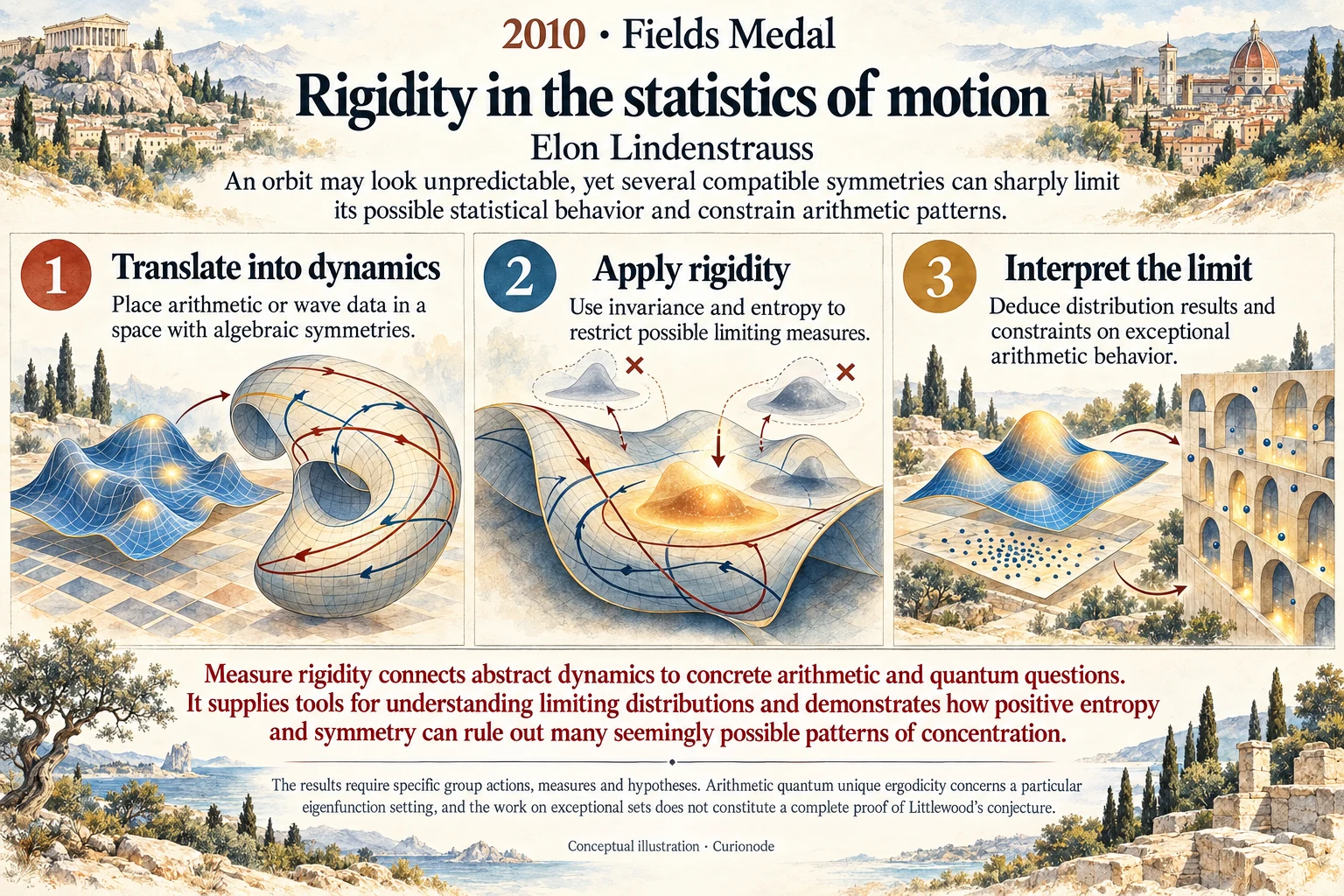
Ergodic theory studies the long-term statistical behavior of transformations that preserve a measure. On homogeneous spaces, these transformations arise from algebraic groups, and number-theoretic questions can become questions about invariant measures. Lindenstrauss proved powerful rigidity results: with enough symmetry and appropriate entropy assumptions, such measures cannot have arbitrary shapes. These ideas helped him prove arithmetic quantum unique ergodicity for suitable Hecke eigenfunctions, showing that their mass spreads in a prescribed way at high energy. With Einsiedler and Katok, related methods severely restricted the possible exceptions to Littlewood’s conjecture. The unifying theme is that several constraints acting together force surprisingly orderly statistics.
Why it matters
Measure rigidity connects abstract dynamics to concrete arithmetic and quantum questions. It supplies tools for understanding limiting distributions and demonstrates how positive entropy and symmetry can rule out many seemingly possible patterns of concentration.