c.curionodeThe Fields Archive

2010 · Probability & dynamics

Why critical random patterns preserve angles

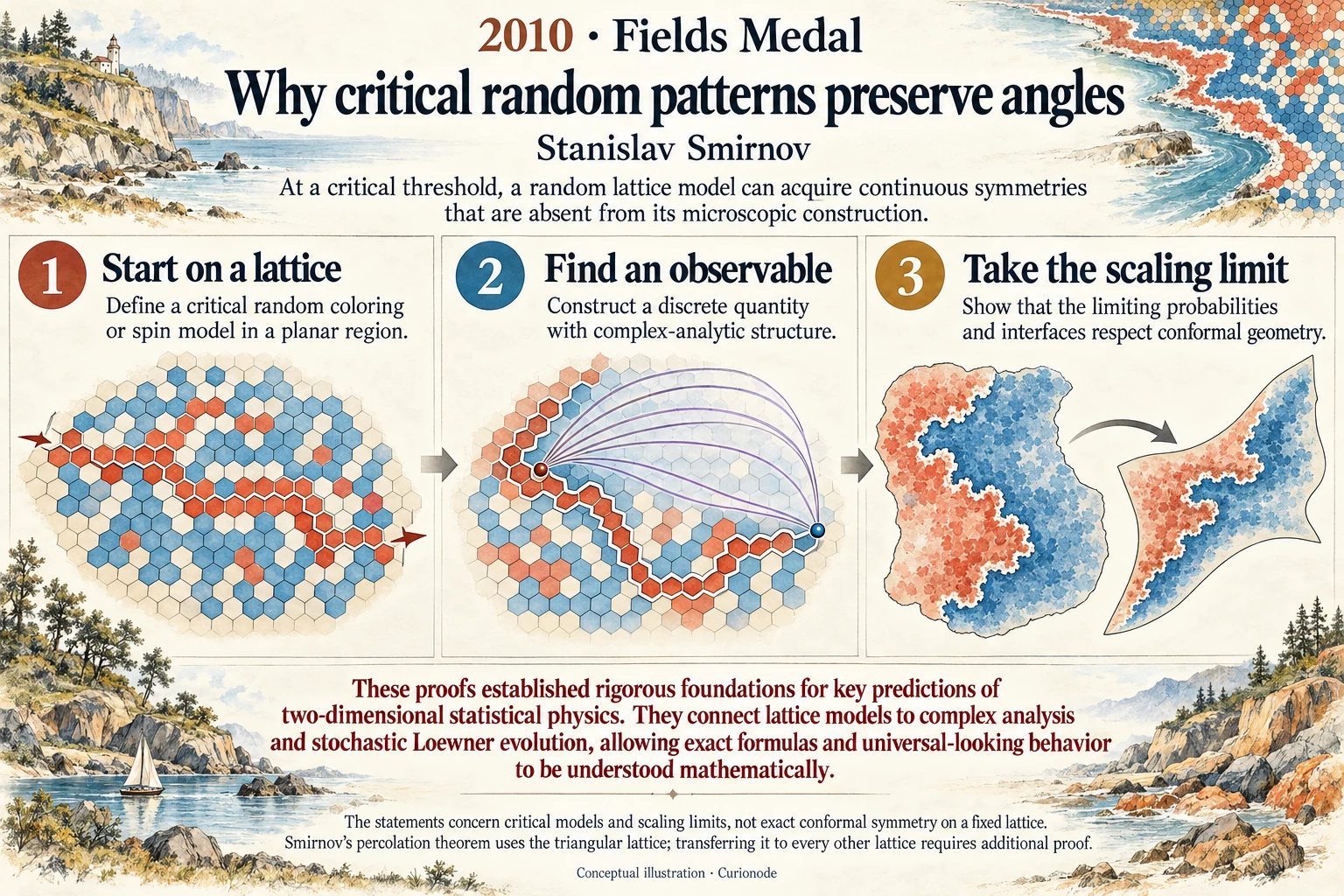
At a critical threshold, a random lattice model can acquire continuous symmetries that are absent from its microscopic construction.

2010Fields Medal
Why critical random patterns preserve angles: At a critical threshold, a random lattice model can acquire continuous symmetries that are absent from its microscopic construction.
Original AI-generated infographic by Curionode. Read the text version below for the full explanation.
Read the poster text
  1. Start on a lattice

    Define a critical random coloring or spin model in a planar region.

  2. Find an observable

    Construct a discrete quantity with complex-analytic structure.

  3. Take the scaling limit

    Show that the limiting probabilities and interfaces respect conformal geometry.

These proofs established rigorous foundations for key predictions of two-dimensional statistical physics. They connect lattice models to complex analysis and stochastic Loewner evolution, allowing exact formulas and universal-looking behavior to be understood mathematically.

The statements concern critical models and scaling limits, not exact conformal symmetry on a fixed lattice. Smirnov’s percolation theorem uses the triangular lattice; transferring it to every other lattice requires additional proof.

01 · The idea

In everyday language

Color sites of a triangular lattice randomly with equal probabilities, and ask whether one color crosses a given region. At the critical value, clusters appear at every scale. Physicists predicted that as the lattice spacing shrinks, crossing probabilities and interfaces should respect conformal maps, transformations preserving local angles. Smirnov found special discrete observables that satisfy analogues of complex-analytic relations. Their continuum limits made conformal invariance rigorous for critical triangular-lattice percolation and, through related work, the planar Ising model. This explains how a discrete model with only a few lattice symmetries can develop a much richer symmetry in its large-scale limit.

Why it matters

These proofs established rigorous foundations for key predictions of two-dimensional statistical physics. They connect lattice models to complex analysis and stochastic Loewner evolution, allowing exact formulas and universal-looking behavior to be understood mathematically.

02 · The people

Who brought the idea to life?

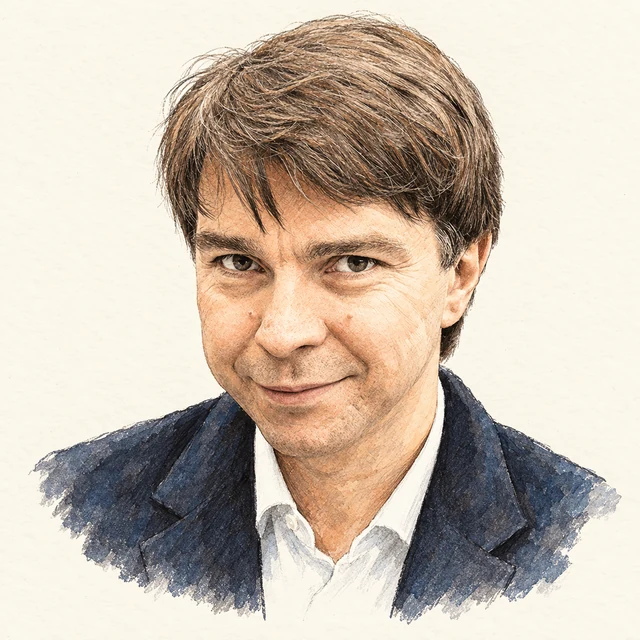
Illustrated portrait of Stanislav Smirnov

Stanislav Smirnov

Stanislav Smirnov was born in Leningrad and studied mathematics in Saint Petersburg before receiving his doctorate at Caltech in 1996. He joined the University of Geneva in 2003 and was a professor there when awarded the 2010 Fields Medal. His work established conformal invariance in the scaling limits of important two-dimensional models of statistical physics, including critical percolation on the triangular lattice and the planar Ising model. He found discrete observables whose properties survive the passage to a continuum. These results made rigorous several powerful predictions about random interfaces, linking probability with complex analysis and geometry.

Read the biography ↗

03 · Read further

From the original sources

Original explanations based on the official award record. The subject label is an editorial navigation aid.

  1. Official IMU citation: Stanislav Smirnov ↗www.mathunion.org
  2. Heidelberg Laureate Forum: Stanislav Smirnov ↗www.heidelberg-laureate-forum.org
  3. University of Geneva: Smirnov receives Fields Medal, 23 August 2010 ↗www.unige.ch
  4. ICM 2010: Smirnov citation and biography ↗www.mathunion.org