c.curionodeThe Fields Archive

2018 · Analysis & PDEs

The geometry of moving mass at minimum cost

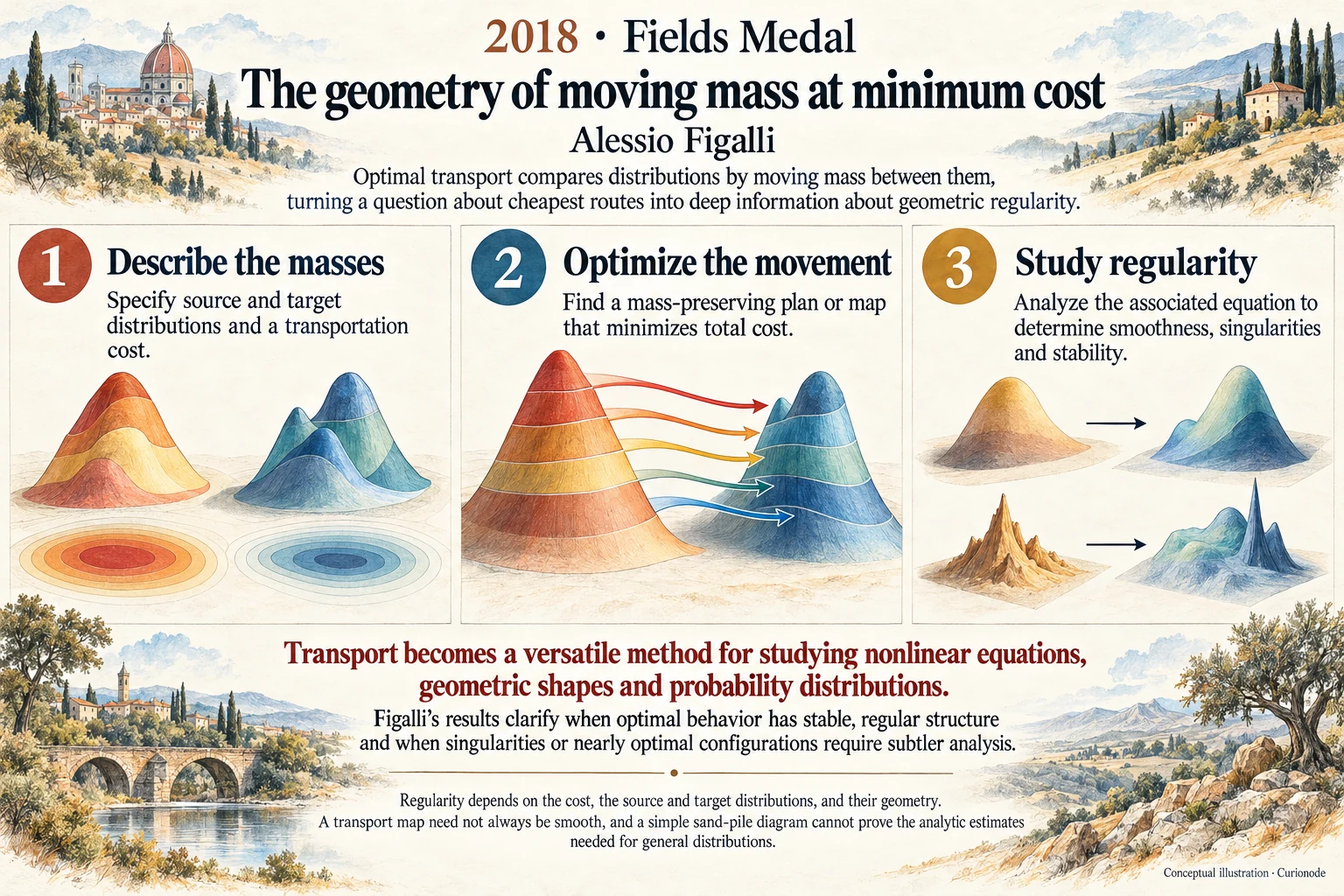
Optimal transport compares distributions by moving mass between them, turning a question about cheapest routes into deep information about geometric regularity.

2018Fields Medal
The geometry of moving mass at minimum cost: Optimal transport compares distributions by moving mass between them, turning a question about cheapest routes into deep information about geometric regularity.
Original AI-generated infographic by Curionode. Read the text version below for the full explanation.
Read the poster text
  1. Describe the masses

    Specify source and target distributions and a transportation cost.

  2. Optimize the movement

    Find a mass-preserving plan or map that minimizes total cost.

  3. Study regularity

    Analyze the associated equation to determine smoothness, singularities and stability.

Transport becomes a versatile method for studying nonlinear equations, geometric shapes and probability distributions. Figalli’s results clarify when optimal behavior has stable, regular structure and when singularities or nearly optimal configurations require subtler analysis.

Regularity depends on the cost, the source and target distributions, and their geometry. A transport map need not always be smooth, and a simple sand-pile diagram cannot prove the analytic estimates needed for general distributions.

01 · The idea

In everyday language

Imagine reshaping one pile of sand into another while minimizing the total transportation cost. Optimal transport turns this picture into a precise problem for probability measures or mass distributions. A cheapest transport plan may exist, but existence alone does not tell us whether the movement is smooth or has sudden discontinuities. Figalli developed tools to understand such regularity questions and the nonlinear equations behind them, notably the Monge–Ampère equation. He also connected transport with sharp geometric inequalities and their stability: if a shape almost achieves an optimal bound, how close must it be to an ideal shape?

Why it matters

Transport becomes a versatile method for studying nonlinear equations, geometric shapes and probability distributions. Figalli’s results clarify when optimal behavior has stable, regular structure and when singularities or nearly optimal configurations require subtler analysis.

02 · The people

Who brought the idea to life?

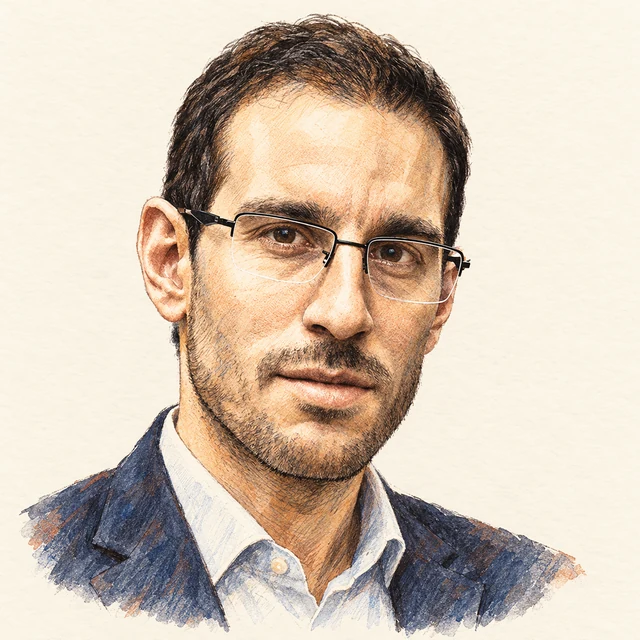
Illustrated portrait of Alessio Figalli

Alessio Figalli

Alessio Figalli was born in Rome and trained in Italy and France. He was a professor at ETH Zurich, which he joined in 2016, when awarded the 2018 Fields Medal. His research centers on optimal transport, the mathematical study of moving one distribution of mass into another at minimum cost. He uses this framework to study nonlinear partial differential equations, geometric inequalities and the regularity of solutions. A central achievement is understanding when transport maps and the equations they satisfy remain well behaved despite rough data or singularities. His work connects abstract optimization with the fine structure of shapes and evolving systems.

Read the biography ↗

03 · Read further

From the original sources

Original explanations based on the official award record. The subject label is an editorial navigation aid.

  1. Official IMU citation: Alessio Figalli ↗www.mathunion.org
  2. Heidelberg Laureate Forum: Alessio Figalli ↗www.heidelberg-laureate-forum.org
  3. ETH Zurich: Alessio Figalli wins the Fields Medal, 1 August 2018 ↗ethz.ch
  4. IMU: Figalli detailed citation ↗www.mathunion.org