c.curionodeThe Fields Archive

1950 · Analysis & PDEs

A broader meaning of a function

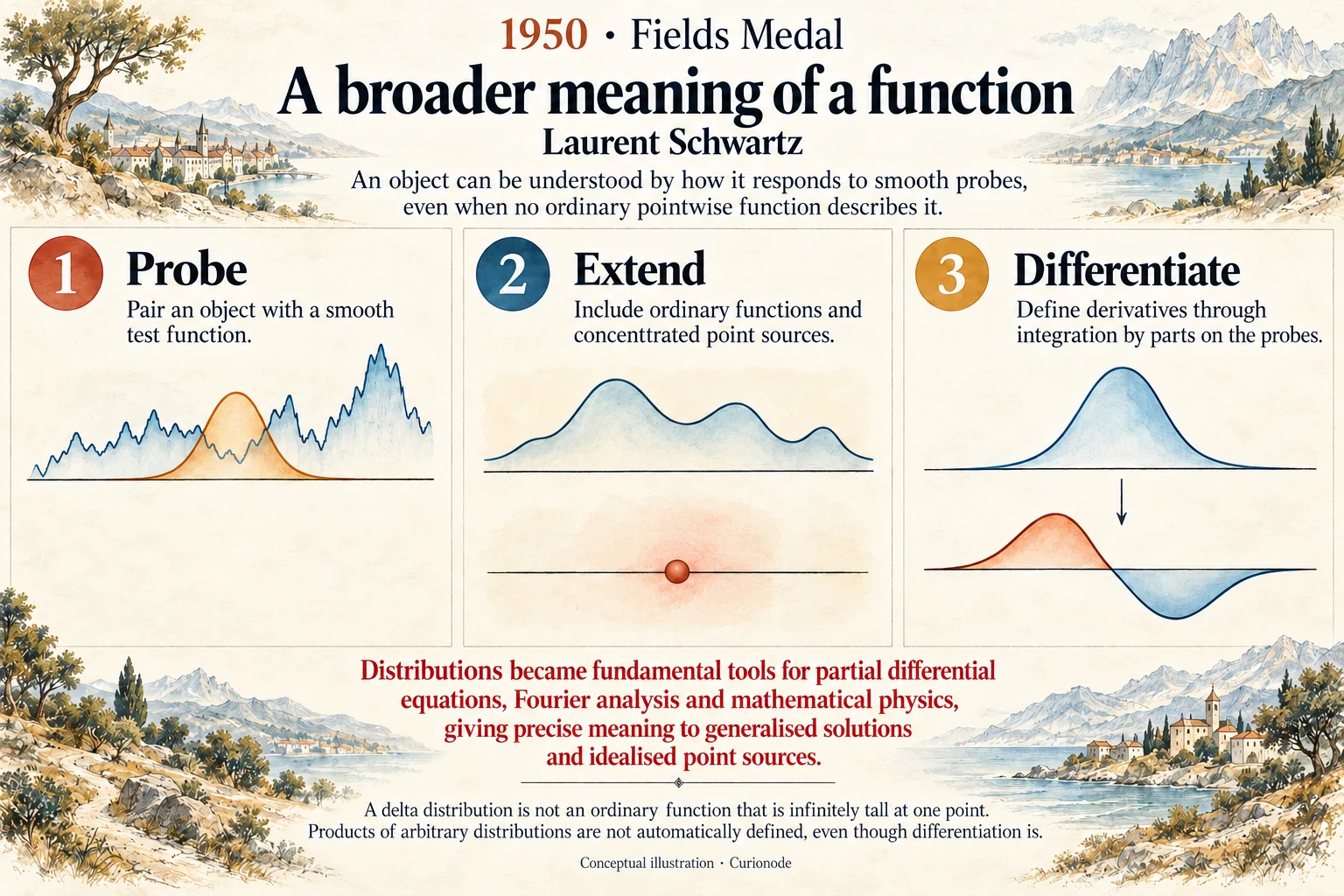
An object can be understood by how it responds to smooth probes, even when no ordinary pointwise function describes it.

1950Fields Medal
A broader meaning of a function: An object can be understood by how it responds to smooth probes, even when no ordinary pointwise function describes it.
Original AI-generated infographic by Curionode. Read the text version below for the full explanation.
Read the poster text
  1. Probe

    Pair an object with a smooth test function.

  2. Extend

    Include ordinary functions and concentrated point sources.

  3. Differentiate

    Define derivatives through integration by parts on the probes.

Distributions became fundamental tools for partial differential equations, Fourier analysis and mathematical physics, giving precise meaning to generalised solutions and idealised point sources.

A delta distribution is not an ordinary function that is infinitely tall at one point. Products of arbitrary distributions are not automatically defined, even though differentiation is.

01 · The idea

In everyday language

An ordinary function assigns a value to each point. A distribution instead assigns a number to each smooth test function, subject to linearity and continuity. Ordinary functions fit this framework by integration. The Dirac delta fits too: it returns the test function’s value at one chosen point. Derivatives are defined by moving differentiation onto the test function with a minus sign, extending integration by parts. Schwartz organised these ideas into a rigorous theory, allowing discontinuous and concentrated phenomena to enter the same analytic language without pretending they are ordinary smooth curves.

Why it matters

Distributions became fundamental tools for partial differential equations, Fourier analysis and mathematical physics, giving precise meaning to generalised solutions and idealised point sources.

02 · The people

Who brought the idea to life?

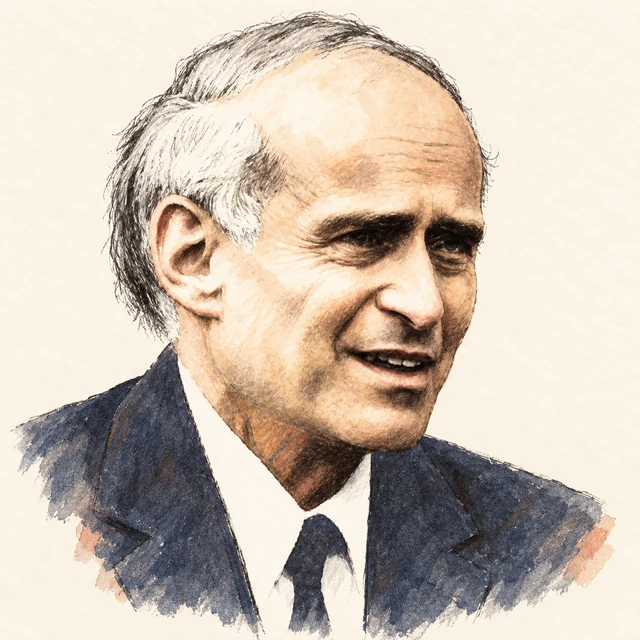
Illustrated portrait of Laurent Schwartz

Laurent Schwartz

Born in Paris in 1915, Laurent Schwartz developed a language for objects that classical functions could not adequately describe. His theory of distributions defined such objects through their action on smooth test functions, making differentiation meaningful in a much wider setting. He received the 1950 Fields Medal while associated with the University of Nancy. The theory clarified operations already used informally in physics and became a standard foundation for partial differential equations. Schwartz also taught extensively and wrote influential expositions, joining conceptual abstraction with a strong commitment to mathematical communication.

Read the biography ↗

03 · Read further

From the original sources

Original explanations based on the official award record. The subject label is an editorial navigation aid.

  1. Official IMU citation: Laurent Schwartz ↗www.mathunion.org
  2. Heidelberg Laureate Forum: Laurent Schwartz ↗www.heidelberg-laureate-forum.org
  3. ENS: Laurent Schwartz, 1950 ↗www.ens.psl.eu